
AIU Campus Plant Profile
Blackboard Tree
Alstonia scholaris (L.) R. Br.
How to Identify
- Size: A large evergreen tree. Thai references give a typical height of 12–20 m for planted and roadside trees; in forest it reaches up to 40 m (rarely 60 m), with narrow buttresses running well up the trunk and giving it a fluted appearance.
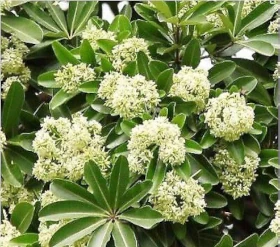
- Crown and branching: The single most recognisable feature — branches emerge in distinct whorled tiers, one layer above another, so the crown looks like a stack of umbrellas (Thai: ฉัตร, a tiered ceremonial parasol).
- Bark: Rough, corky, grey to grey-white with small scales, yellowish inside, and it bleeds copious bitter white latex when cut.
- Leaves: In whorls of 4–8 (usually 5–7) around the twig — this whorl is what gives both the Sanskrit name Saptaparni (“seven leaves”) and the Thai name “duck’s foot.” Each leaf is obovate, leathery, 10–20 cm long, glossy dark green above and distinctly whitish beneath, with fine lateral veins running almost at right angles to the midrib.
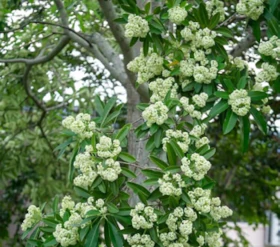
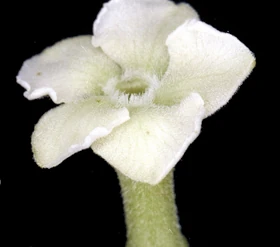
- Flowers: Small, creamy to greenish-white, tubular, borne in dense umbel-like clusters at branch tips. They open at dusk and release a very strong, heavy scent.
- Fruit: Long, slender, hanging paired follicles, 20–60 cm long and pencil-thin, green ripening to brown. They split lengthwise to release many small seeds, each tufted with silky hairs for wind dispersal.
Ecological Importance
- Night pollinator support: The flowers are adapted for moth pollination — dusk opening, pale colour, strong odour, and little nectar — and are also visited by bees, flies, and butterflies.
- Canopy and shade: A fast-growing tiered canopy tree that gives dense shade and shelter, and functions as an important canopy species supporting biodiversity.
- Wind dispersal and regeneration: Silky-haired seeds spread widely on the wind during the dry season; the tree coppices and produces root suckers after damage, so it recovers quickly.
- Soil stabilisation: Used in afforestation and roadside planting for shade and soil holding.
- Defence: The bitter latex deters herbivores — one reason the tree has almost no pest problems.
Uses and Importance
Food — None
This is not a food plant. No part is eaten. The tree is toxic and the milky latex is bitter and irritant. Its only food-web role is as nectar for night-flying insects.
Medicinal — By Part and Ailment
Traditional and experimental uses. The bark is a genuine historical drug, but the plant is toxic — never self-medicate.
| Part | Traditionally Used For |
|---|---|
| Stem bark (“Dita bark”) — the main drug | Malaria and fever; chronic diarrhoea and dysentery; asthma and bronchitis; intestinal worms; skin diseases, ulcers and tumours; as a bitter tonic and to promote milk flow in nursing mothers |
| Leaves | Chronic cough and respiratory disease (a leaf preparation is used in traditional Chinese medicine); poultice on ulcers and wounds |
| Latex | Applied to ulcers, sores, and for toothache |
| Root / root bark | Fever and snakebite in traditional practice; studied for anticancer activity |
Key research findings
- The active compounds are indole alkaloids — echitamine, ditamine, echitenine, alstonine, picrinine, scholaricine.
- The bark was listed in the British Pharmacopoeia (1914) as an antimalarial, and early clinical trials in Manila and India showed it reduced malarial fever. Echitamine kills Plasmodium falciparum in vitro, and akuammidine from the leaves is antiplasmodial.
- Anticancer: echitamine chloride produced strong tumour regression in rats with induced fibrosarcoma; anticancer activity is reported from stem bark, root bark, and leaves.
- Anti-inflammatory: an ethanolic bark extract suppressed retinoid-induced skin irritation, with echitamine and loganin identified as the active components.
- Respiratory: leaf extracts show broncho-vasodilatory activity, supporting the traditional asthma use.
Economic
The timber, traded as pulai, is light, soft, and white. The species name scholaris comes from its historic use for school blackboards in Southeast Asia. It is also worked into pencils, coffins, matchsticks, packing cases, plywood, and moulds, and the bark is traded medicinally. It is widely planted as a shade and avenue tree.
Cultural
- In Thailand พญาสัตบรรณ is considered a prestigious and auspicious tree (พญา = “lord”), commonly planted at temples, schools, and government offices. It is the provincial tree of Samut Sakhon and the district tree of Phaya Thai in Bangkok.
- In India it is Saptaparni, used in Ayurveda, and it is the sacred tree of Ajitnatha, the second Jain Tirthankara.
- The genus honours the Scottish botanist Charles Alston; Linnaeus first named it Echites scholaris in 1767 and Robert Brown moved it to Alstonia in 1810.
Distribution & Habitat
- Origin: Native to South and Southeast Asia and Australasia — its natural range runs from Pakistan and the Indian subcontinent through Southeast Asia to southern China and northern Australia. Thai sources confirm it as native to Southeast Asia and found in every region of Thailand.
- Habitat: Lowland forest, riverbanks and riparian zones, and disturbed ground such as roadsides, from sea level to about 1,200 m. It prefers warm climates and well-drained soil, and grows fast.
- Conservation status: Least Concern (IUCN).
Flowering & Fruiting
Flowering: An evergreen, winter-blooming tree. In Thailand, it flowers once a year at the end of the rains into the cool season — roughly October to December. Flowers open at dusk and into the early dark hours, which is when the scent is strongest.
Pollination and breeding: Moth-pollinated, with bees, flies, and butterflies as secondary visitors. The tree is hermaphroditic, self-compatible, and can self-pollinate.
Fruiting and dispersal: Fruits are paired, many-seeded follicles. Seeds are released from the splitting pod and then carried by wind on their silky hairs; the dry season is the effective dispersal window.
Did You Know?
- The tree is named after school blackboards. Scholaris means “used for schools” — the soft white timber was the standard material for blackboards in Java and Myanmar, which is also where the English name Blackboard Tree comes from.
- Its famous scent is a documented public-health complaint. Where the tree is mass-planted along city streets, the pungent flowers have been shown to cause mild breathing difficulty and disturbed sleep in cool weather, worsened by the sheer number of flowers each tree opens nightly. Every Thai cool season brings the same complaints in Bangkok — which is exactly why it should be sited thoughtfully on a campus, away from dormitory windows.
- Do not confuse it with ตีนเป็ดน้ำ. Cerbera odollam — the “sea mango” or pong-pong tree — shares the Thai nickname “duck’s foot” and is a highly poisonous relative. It is smaller, grows near water, has alternate (not whorled) leaves, round fruits instead of long pods, and a much milder scent. A. scholaris is taller, has whorled tiered branches, pencil-thin paired pods, and an overpowering flower scent.
References
- Khyade, M.S., Kasote, D.M. & Vaikos, N.P. (2014). Alstonia scholaris (L.) R. Br. and Alstonia macrophylla Wall. ex G. Don: A comparative review on traditional uses, phytochemistry and pharmacology. Journal of Ethnopharmacology, 153(1): 1–18.
- Baliga, M.S. (2010, 2012). Reviews of the chemistry and pharmacology of Alstonia scholaris. Integrative Cancer Therapies, 8: 273–279 and 9: 261–269.
- Kamarajan, P., Sekar, N., Mathuram, V. et al. (1991). Antitumor effect of echitamine chloride on methylcholanthrene-induced fibrosarcoma in rats. Biochemistry International, 25(3): 491–498.
- Channa, S., Dar, A., Ahmed, S. et al. (2005). Evaluation of Alstonia scholaris leaves for broncho-vasodilatory activity. Journal of Ethnopharmacology, 97: 469–476.
- Keawpradub, N., Kirby, G.C., Steele, J.C. et al. (1999). Antiplasmodial activity of extracts and alkaloids of three Alstonia species from Thailand. Planta Medica, 65(8): 690–694.
- Solomon Raju, A.J. & Devi, D. (2021). Indian Devil Tree, Alstonia scholaris: pollination ecology and seed dispersal versus human health. Species, 22(69): 153–163.
- Kaewkroek, K. et al. (2020). Pharmaceutical perspective on bioactives from Alstonia scholaris. Phytochemistry Reviews. doi:10.1007/s11101-020-09662-z
- Faculty of Pharmaceutical Sciences, Khon Kaen University — พญาสัตบรรณ herb record. https://pharmoffice.kku.ac.th/iss/smhcontrol/herb/296
- Thai Wikipedia — พญาสัตบรรณ (provincial tree, dimensions, local names).