
AIU Campus Plant Profile
Paper Flower
Bougainvillea glabra Choisy
How to Identify
- Habit: A woody, scrambling shrub or climber, usually 3–4 m tall but reaching up to 9 m when it has support to climb on.
- Stems: Armed with sharp thorns, used for scrambling over walls, fences and other plants.
- Leaves: Alternate, lance- to egg-shaped, smooth, dark green, up to about 10 cm long.
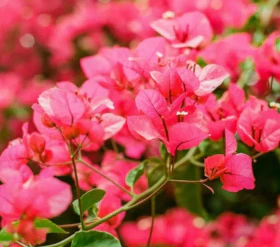
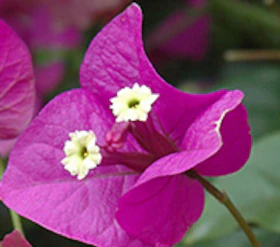
- Flowers: The showy part is not the flower — the true flowers are small white or cream tubes, only about 4 mm across, borne in groups of three. Each trio is surrounded by three papery bracts up to 5 cm long, in magenta, purple, pink or red.
- Distinguishing feature: The name glabra means “hairless,” referring to the smooth leaves and stems — this is what separates it from the hairy-leaved B. spectabilis.
- Fruit: A small, dry, ribbed achene, rarely seen on cultivated plants since most are propagated from cuttings.
Ecological Importance
- Pollinator support: A long flowering season supplies nectar for bees, butterflies, and sunbirds.
- Shelter: The dense, thorny thickets give small birds safe nesting and roosting sites.
- Soil stabilisation: Deep-rooted and drought-hardy, it holds soil on banks and slopes.
- Living structure: Widely used as a living fence, screen, or windbreak in full sun.
- Note on origin: It is an introduced ornamental in Thailand, not part of the native flora, and it has naturalised in many tropical regions worldwide.
Uses and Importance
Food
Not a food plant. The colourful bracts are used decoratively and occasionally in herbal infusions, but the plant has no significant dietary use.
Medicinal
Widely used in traditional medicine for respiratory complaints such as cough, asthma, and bronchitis, and for gastrointestinal problems, with reported antibacterial and insecticidal properties. The plant contains phenols, terpenes, and betalains. This reflects traditional use only and is not a substitute for medical treatment.
Economic
Bougainvillea glabra is one of the three parent species behind the world's ornamental bougainvilleas, with more than 400 cultivars developed by hybridising it with B. spectabilis and B. peruviana. It is a mainstay of the nursery, landscaping, hedge, and bonsai trade.
Cultural
- In Thailand, the name เฟื่องฟ้า is linked to เฟื่องฟู (“flourishing”), so it is planted as an auspicious tree believed to bring prosperity to the household.
- It is the provincial flower of Songkhla.
- The central-Thai name ตรุษจีน reflects its heavy bloom around Chinese New Year.
Distribution & Habitat
- Origin: Native to eastern and southern Brazil, where it grows as a climbing shrub or liana in the wet tropical biome, occurring in forest, scrubland, and semi-deciduous habitats between about 500 and 1,500 m.
- Current range: Now cultivated throughout the tropics and subtropics as an ornamental.
- Growing conditions: Wants full sun and well-drained soil, tolerates poor soil, heat, and long dry spells, but is damaged by frost — conditions that suit the Muak Lek campus well, where it is grown on walls, fences, and as clipped hedges.
Flowering & Fruiting
Flowering: Flowers on and off all year in Thailand, with the heaviest display in the cool, dry months from roughly November to February. Bloom is triggered by dry conditions and bright sun, which is why gardeners deliberately withhold water to force flowering. The coloured bracts stay on the plant for several weeks.
Fruiting: Fruit set is uncommon in cultivation because most plants are clones grown from cuttings rather than seed.
Did You Know?
- Named after a French navigator. The genus honours Louis Antoine de Bougainville, whose 1760s voyage carried the first specimens to Europe.
- The "flower" isn't a flower. What everyone calls the flower is really three modified leaves (bracts). The actual flower is the tiny white tube in the centre — look for the three white tubes to tell a bougainvillea from any other papery-bracted plant.
- Stress makes it beautiful. A well-watered, well-fed bougainvillea grows leaves, while a thirsty one in poor soil produces the best colour.
References
- Plants of the World Online, Royal Botanic Gardens Kew — Bougainvillea glabra Choisy. powo.science.kew.org
- Zhang, H. et al. (2023). Complete chloroplast genomes and phylogenetic relationships of Bougainvillea spectabilis and B. glabra. International Journal of Molecular Sciences, 24: 13044.
- Review of the phytochemistry and antimicrobial potential of Bougainvillea glabra Choisy. PMC10620508.
- เฟื่องฟ้า — Thai Wikipedia / สวนพฤกษศาสตร์โรงเรียน plant records (Thai local names and description).