
AIU Campus Plant Profile
Queen's Crape Myrtle
Lagerstroemia speciosa (L.) Pers.
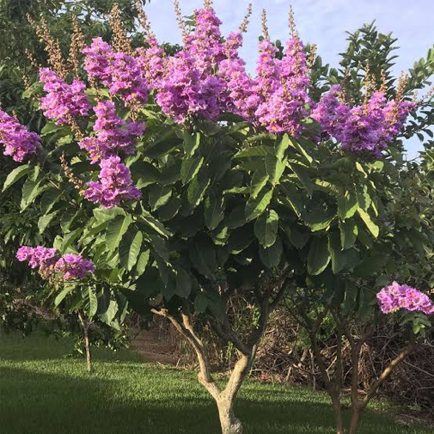
Four look-alikes worth sorting out. Four related Lagerstroemia species are all planted along Thai streets and are constantly mixed up — in order of how commonly they are planted: อินทนิลน้ำ (L. speciosa), เสลา (L. loudonii), ตะแบก (L. floribunda) and อินทนิลบก (L. macrocarpa). On Bangkok avenues three of them often grow side by side. L. speciosa is told by its greyish to pale brown, fairly smooth bark and its hairless leaves with a slender pointed tip, and by the fact that it flushes a full crown of new leaves at the same time as it flowers.
How to Identify
- Habit: A medium to large deciduous tree, 5–20 m tall, though it re-foliates so quickly that it is rarely bare for long. Young trees are often crooked; mature trees have a straight, clean bole with little or no buttressing, and large branches leaving the trunk fairly low down, so the crown is broad and umbrella-shaped, covering roughly nine-tenths of the tree's height.
- Bark: Grey to pale brown, about 1 cm thick, smooth — not deeply fissured or scarred — flaking in thin papery patches and often mottled with pale whitish blotches.
- Leaves: Simple, opposite or nearly so, large, leathery, oblong to elliptic, hairless (glabrous) with a slender, drawn-out pointed tip. They turn red before falling.
- Flowers — the reason it is planted: Large, showy, six-petalled flowers in erect terminal panicles, in pink, mauve, purple or pinkish violet. The petals are crinkled like crêpe paper, which is where "crape myrtle" comes from, and the center is filled with a mass of yellow stamens. The display lasts for months.
- Fruit: A hard, woody, rounded capsule about 2–3 cm across, green ripening to brown, splitting into 6 valves to release many small, winged seeds. Old capsules persist on the tree through the dry season.
Ecological Importance
- A riparian and wetland tree. The Thai name อินทนิลน้ำ — "water inthanin" — records its habitat: riverbanks, streamside and moist lowland forest. It tolerates seasonally wet ground far better than most of the trees in this series, which makes it a good species for pond margins and damp corners on campus.
- Bank stabilization: planted along waterways to hold soil.
- Pollinator support: the large open flowers with abundant stamens are worked heavily by carpenter bees and honeybees — the pollen is the reward, since these flowers offer little nectar.
- Wind dispersal: the winged seeds are shed from the splitting capsules during the dry season.
- Native, not introduced. Unlike most of the ornamental trees in this series, L. speciosa is a genuine Thai native — one of the few campus trees that belongs to the local flora rather than arriving through horticulture.
Conservation note: the species overall is common and widely planted, but the subspecies L. speciosa subsp. intermedia, found in Thailand and China, is assessed as Vulnerable (IUCN) and threatened by habitat loss.
Uses and Importance
Food
- Not a food crop — no part is a vegetable or fruit.
- Its food-adjacent use is as a herbal tea: dried banaba leaves are brewed and drunk as a beverage across Southeast Asia, and banaba leaf extract is sold worldwide as a dietary supplement. The flowers also supply pollen for bees.
Medicinal — By Part and Ailment
This is one of the best-researched medicinal trees on campus, with genuine human trial data. It is still not a substitute for prescribed diabetes medication — do not self-medicate, and anyone on glucose-lowering drugs should be especially careful.
| Part | Traditionally Used For / Documented Activity |
|---|---|
| Leaves — by far the most important part | Diabetes — a hot-water leaf decoction is the classic Philippine folk remedy, in use long before the first published study in 1940. Also used for kidney and bladder complaints, hypertension, and weight loss. Documented antibacterial, antiviral, anti-inflammatory, anti-obesity, anti-fibrotic, antidiabetic, diuretic and decongestant activity, plus xanthine oxidase inhibition (relevant to gout) |
| Bark | Used in Malaysian traditional medicine for dysentery and diarrhoea, and to relieve abdominal pain |
| Roots | Applied for mouth ulcers |
| Flowers | Extracts show antioxidant and antimicrobial activity |
| Fruit | Extracts show anti-nociceptive (pain-relieving), anti-diarrhoeal and cytotoxic activity |
The science behind the diabetes use
- The active compound is corosolic acid (2-hydroxyursolic acid), a triterpenoid nicknamed "plant insulin." A second group of actives, the ellagitannins — lagerstroemia, flosin B and reginin A — act as glucose-transport enhancers.
- Human data: pure corosolic acid has been reported to lower blood glucose within 60 minutes in human subjects, and an extract standardized to 1% corosolic acid produced roughly a 30% reduction in blood glucose after two weeks.
- Mechanisms appear to be multiple: increased cellular glucose uptake, inhibition of the hydrolysis of starch and sucrose, decreased gluconeogenesis, and regulation of lipid metabolism, mediated through PPAR, MAP kinase and NF-κB signaling.
- Corosolic acid additionally shows antihyperlipidemic, antioxidant, anti-inflammatory, antifungal, antiviral, antineoplastic, and osteoblastic activity.
- Safety: reviewers note that no adverse effects have been observed in animal studies or controlled human trials — an unusually clean record for a herbal antidiabetic.
Economic
- Timber: the wood is strong and durable — described as second only to teak in strength — and is used for construction, boat building, railway sleepers, furniture and carts.
- Ornamental: one of the most planted flowering street and park trees in Thailand and across tropical Asia.
- Supplements: banaba leaf extract standardised to corosolic acid is an internationally traded ingredient for blood-sugar and weight-management products.
Cultural
- Provincial tree of Sakon Nakhon and of Ranong in Thailand.
- The epithet speciosa is Latin for "beautiful," and the old names reginae and flos-reginae — "of the queen," "the queen's flower" — gave the tree its English name.
- The genus honours Magnus von Lagerström, an eighteenth-century Swedish merchant and friend of Linnaeus.
- อินทนิล is a long-established ornamental in Thai city planting; along a single Bangkok avenue such as Phetchaburi Road you can find อินทนิลน้ำ, เสลา and ตะแบก growing together.
Distribution & Habitat
- Origin: Native to tropical South Asia, Southeast Asia and Melanesia — including Bangladesh, India, Indonesia, Malaysia, the Philippines and Thailand, where it is common.
- Habitat: Moist lowland forest, riverbanks and streamsides. It prefers deep, moist, well-drained soil and full sun, tolerates seasonally wet ground, and is not suited to prolonged drought.
- Present range: Widely planted as an ornamental and shade tree throughout the tropics.
Flowering & Fruiting
Flowering: The main flush comes in the hot and early rainy season — roughly March to June in Thailand — and the display "lasts for many months," since panicles open in succession along the branch.
A useful identification timing note: L. speciosa flushes a full crown of new leaves at the same time as it flowers, so the tree is green and flowering together. Its relatives ตะแบก and เสลา behave differently, which is one of the easiest ways to separate them in the field.
Pollination: Chiefly by large bees collecting pollen.
Fruiting: Woody capsules develop over the following months, ripening brown and splitting into six valves to release winged seeds. Empty capsules stay on the tree well into the next season.
Propagation: By seed, which germinates readily.
Did You Know?
- The most studied "diabetes tree" in Southeast Asia is standing on your campus. Banaba leaf tea has been a Philippine folk remedy for diabetes for centuries, and unlike most such claims, it has been followed up: research began in 1940, and pure corosolic acid from the leaves has been shown to lower blood glucose in humans within an hour. Reviewers have found no adverse effects in controlled human trials.
- Its flowers are named for crêpe paper, and the tree for a queen. The crinkled six petals look exactly like crêpe, giving "crape myrtle." The older botanical names reginae and flos-reginae mean "the queen's flower" — and speciosa simply means "beautiful."
- It is one of the few genuinely Thai trees in this series. Most of the showy campus trees — bougainvillea, tecoma, flamboyant, rain tree, traveller's tree — are imports from the Americas, Madagascar or Mauritius. อินทนิลน้ำ is native here, grows wild along Thai rivers, and is the provincial tree of two Thai provinces.
References
- Stohs, S.J., Miller, H. & Kaats, G.R. (2012). A review of the efficacy and safety of banaba (Lagerstroemia speciosa L.) and corosolic acid. Phytotherapy Research, 26(3): 317–324. PMID: 22095937.
- Klein, G., Kim, J., Himmeldirk, K., Cao, Y. & Chen, X. (2007). Antidiabetes and anti-obesity activity of Lagerstroemia speciosa. Evidence-Based Complementary and Alternative Medicine, 4(4): 401–407.
- Management of diabetes and its complications with banaba (Lagerstroemia speciosa L.) and corosolic acid (2012). Journal of Nutrition and Metabolism. PMC3468018.
- Judy, W.V., Hari, S.P., Stogsdill, W.W. et al. (2003). Antidiabetic activity of a standardized extract (Glucosol) from Lagerstroemia speciosa leaves in Type II diabetics: a dose-dependence study. Journal of Ethnopharmacology, 87(1): 115–117.
- Hayashi, T., Maruyama, H., Kasai, R. et al. (2002). Ellagitannins from Lagerstroemia speciosa as activators of glucose transport in fat cells. Planta Medica, 68(2): 173–175.
- A review on Lagerstroemia speciosa (2017). International Journal of Pharmaceutical Sciences and Research.
- Integrating bioactivity and molecular simulations to explore the pharmacological landscape of Lagerstroemia speciosa leaf extract. PMC12747374.
- Drugs.com Natural Products Database — Banaba: constituents, uses and dosage.
- Wikipedia — Lagerstroemia speciosa and L. speciosa subsp. intermedia (names, timber strength, IUCN status of the subspecies).
- Office of the Royal Society of Thailand (สำนักงานราชบัณฑิตยสภา) — อินทนิล เสลา ตะแบก: distinguishing the four Thai Lagerstroemia. royin.go.th
- Vayo Farm — อินทนิล หรือ อินทนิลน้ำ: Thai description, height, bark, crown form, provincial tree status.