
AIU Campus Plant Profile
Frangipani
Plumeria sp. — P. alba L. [P. rubra, P. obtusa, P. pudica]
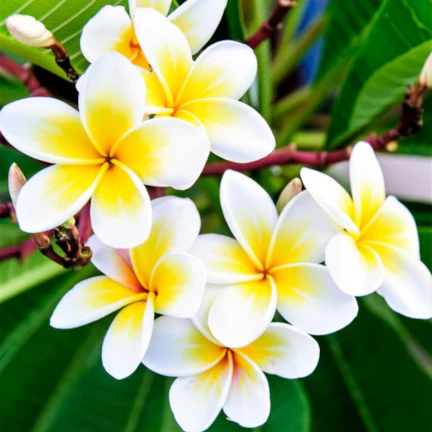
Note on spelling and identity: the genus is Plumeria, not "Plumera." Campus plants are almost always Plumeria rubra (pointed leaf tips, deciduous, many colours) or Plumeria obtusa (rounded leaf tips, glossier, more evergreen, white with a yellow throat), plus hybrids of the two.
How to Identify
- Habit: A small deciduous tree or large shrub, usually 3–8 m tall, with an open, irregular crown. The branches are thick, blunt and succulent-looking, forking repeatedly — the silhouette alone identifies the genus.
- Bark and sap: Bark is smooth, grey to grey-green, becoming slightly rough with age. Every cut surface bleeds copious milky white latex, which is bitter and irritant.
- Leaves: Large, simple, leathery, clustered in a spiral at the tips of the branches so that the ends of bare branches carry rosettes of foliage. The lateral veins run almost parallel and join a continuous vein around the leaf margin — a reliable Apocynaceae character. P. rubra has pointed leaf tips; P. obtusa has rounded (obtuse) tips.
- Flowers: Five thick, waxy petals overlapping in a pinwheel, fused below into a narrow tube. Colours range from white with a yellow throat through pink, apricot, and deep red, often several shades in one flower. Strongly fragrant, and most powerfully so in the evening and at night.
- Fruit: A pair of long, slender, horn-like follicles, green ripening to brown, splitting along one side to release many flat winged seeds. Rarely seen on cultivated plants.
Ecological Importance
Pollination by Deception — the Standout Fact
Frangipani flowers produce a powerful sweet fragrance but no nectar at all. Night-flying hawkmoths (sphinx moths) are drawn in by the scent, probe the flowers, receive no reward, and move on — carrying pollen as they go. The plant advertises a meal it never provides.
Other Ecological Notes
- Wind dispersal: the winged seeds are carried on the wind when the follicles split, though most cultivated plants never fruit.
- Herbivore defence: the bitter, toxic latex protects the plant, which is why frangipani has almost no browsing damage.
- Tough-site tolerance: highly drought- and salt-tolerant, thriving on poor, shallow, well-drained soils — useful on dry banks and coastal ground.
- An honest limitation: because the flowers offer no nectar and the plant is toxic to most herbivores, its direct value to local wildlife is low compared with the other flowering trees in this series. Its role on campus is ornamental and cultural rather than ecological.
Campus health note — frangipani rust. Coleosporium plumeriae causes bright orange powdery pustules on the undersides of leaves, followed by yellow blotching and early leaf fall. It is the most common frangipani problem in Thailand. Rake up and remove fallen leaves rather than leaving them under the tree.
Uses and Importance
Food — None
Not a food plant. No part is eaten. The milky latex is bitter, irritant, and purgative in quantity. The flowers' contribution is fragrance, not food: their essential oil — rich in geraniol, citronellol, farnesol, linalool and phenylethyl alcohol — is used in perfumery and flavouring, not as an ingredient in cooking.
Medicinal — by Part and Ailment
Traditional and experimental uses only. The plant is toxic — do not self-medicate.
| Part | Traditionally used for / documented activity |
|---|---|
| Stem bark | The main traditional drug: rheumatism, diarrhoea, venereal disease, blennorrhoea, leprosy, and as a purgative and diuretic. Bark compounds show antibacterial, antifungal and antialgal activity. |
| Latex | Applied traditionally to toothache and skin complaints. A protease named plumerin-R, isolated from P. rubra latex, showed anti-inflammatory and wound-healing activity; latex proteins also protected against ethanol-induced gastric ulceration in rats. |
| Leaves | A decoction for wounds and skin disorders; leaf extracts show anti-inflammatory activity in both acute and chronic models. |
| Flowers | Used in cosmetics and aromatherapy; flower extracts of P. rubra var. acutifolia produced an anxiolytic (anti-anxiety) effect in mice. |
| P. obtusa (whole plant) | Traditionally used for gastrointestinal complaints, diabetes, malaria, fever and pain; a leaf-based wound-healing spray has been evaluated in rats. |
Active compounds: the genus is defined chemically by its iridoids — plumieride, plumericin, isoplumericin, fulvoplumierin, allamandin and allamcin — together with triterpenoids (lupeol, ursolic and oleanolic acid), the antibacterial triterpenoid rubrinol, sterols, scopoletin, and flavonoids. More than 110 compounds have been isolated from P. rubra alone.
Safety: the latex irritates skin and eyes and is a strong purgative if swallowed. Wear gloves when pruning and keep cuttings away from young children.
Economic
- Ornamental — overwhelmingly the main value. Frangipani cultivar collecting is a serious hobby industry in Thailand, and named colour forms command high prices.
- Cut flowers and garlands — including the Hawaiian lei, and temple offerings across Southeast Asia.
- Perfumery, cosmetics and aromatherapy — frangipani absolute is a recognised fragrance material.
- Propagation is trivially easy from cuttings, which keeps nursery costs low and makes it a standard landscape plant.
Cultural
- The temple tree. Frangipani is planted at Buddhist temples throughout Southeast Asia, which is the origin of the English names Temple Tree and Pagoda Tree.
- The Thai name change. Traditionally the tree was not planted at houses, because ลั่นทม echoes ระทม, "sorrow" or "grief," and was therefore considered inauspicious. Under the modern name ลีลาวดี — "the flowering tree of graceful bearing" — it became enormously popular in home gardens. Sources disagree about where the new name came from: several Thai references credit HRH Princess Maha Chakri Sirindhorn with bestowing it, while others state flatly that it is not a royally bestowed name. Present it as disputed rather than settled.
- An alternative etymology derives ลั่นทม from ลั่นธม, commemorating Angkor Thom, or reads ลั่น ("to cast off") + ทม ("sorrow") as the letting go of sorrow — the opposite of the unlucky reading.
- National flower of Laos, where it is ດອກຈຳປາ (dok champa).
- The genus honours Charles Plumier, the seventeenth-century French botanist.
Distribution & Habitat
- Origin: Native to the Americas — from Mexico, Central America and the Caribbean south to Brazil, and into Florida. It is not a native Thai plant; it arrived through introduction, and old specimens are found at palaces and temples.
- Present range: Pantropical, planted everywhere in the warm tropics and subtropics, and grown in greenhouses beyond them.
- Habitat preferences: Full sun and sharply drained soil. Strongly drought-tolerant and salt-tolerant; it stores water in its thick stems. It will rot in waterlogged ground, which is the single most common cause of failure in Thai gardens.
Flowering & Fruiting
Flowering: Long-flowering through the hot and rainy seasons — roughly March to October in Thailand — with the heaviest flush in the hot season. P. rubra is deciduous and typically bare through the cool season, flowering as the new growth comes.
Fragrance timing: Scent is released most strongly in the evening and at night, matching its hawkmoth pollinators.
Fruiting: Uncommon in cultivation. Where seed does set, the paired follicles take months to ripen before splitting to shed winged seeds.
Propagation: Almost always by stem cuttings, which root readily after the cut end is allowed to dry for several days. Named colour cultivars are therefore clones — another reason cultivated frangipani so seldom produces seed.
Did You Know?
- The flowers are a beautiful lie. Frangipani produces one of the strongest floral scents in any garden and no nectar whatsoever. Hawkmoths follow the fragrance in the dark, find nothing, and pollinate the flower on their way to the next disappointment — one of the clearest cases of pollination by deception you can point to on a campus walk.
- A change of name changed where the tree is planted. For generations Thai households avoided ลั่นทม because it sounded like the word for grief, so the tree lived at temples and in public gardens. Renamed ลีลาวดี, the very same plant became a favourite for home gardens. Whether that name was royally bestowed is genuinely disputed among Thai sources — which makes it a good exercise in checking claims.
- Nearly every frangipani you see is a cutting, not a seedling. Because named colour forms are propagated as clones, most cultivated trees are genetically identical to their parent — which is why the long paired seed pods are such an uncommon sight, and worth photographing if your campus tree produces them.
References
- Bihani, T. (2021). Plumeria rubra L. — a review on its ethnopharmacological, morphological, phytochemical, pharmacological and toxicological studies. Journal of Ethnopharmacology, 264: 113291.
- Plumeria obtusa L.: a systematic review of its traditional uses, morphology, phytochemistry and pharmacology (2021). Pharmacological Research — Modern Chinese Medicine / ScienceDirect S2667031321000348.
- Choudhary, M. et al. (2014). Phytochemical and pharmacological activity of genus Plumeria: an updated review. International Journal of Biomedical and Advance Research.
- Chanda, I. et al. (2011). A protease isolated from the latex of Plumeria rubra Linn (Apocynaceae) 2: anti-inflammatory and wound healing activities. Tropical Journal of Pharmaceutical Research, 10: 755.
- Alencar, N.M.N. et al. The preventive effect on ethanol-induced gastric lesions of the medicinal plant Plumeria rubra: involvement of the latex proteins in the NO/cGMP/KATP signalling pathway. Evidence-Based Complementary and Alternative Medicine, 706782.
- Chatterjee, M. et al. (2013). Anxiolytic effects of Plumeria rubra var. acutifolia flower extracts in the elevated plus-maze model of anxiety in mice. Asian Journal of Psychiatry, 6: 113.
- Bihani, T. (2019). Evaluation of in vivo wound healing activity of Plumeria obtusa L. (Champa) spray in rats. Wound Medicine, 28: 100176.
- Albers-Schönberg, G. & Schmid, H. (1962). Die Struktur des Fulvoplumierins. Helvetica Chimica Acta, 45: 1406.
- Shinde, P.R. et al. (2014). Phytopharmacological review of Plumeria species. Scholars Academic Journal of Pharmacy, 3(2): 217–227.
- Thai Wikipedia — ลั่นทม (genus, origin, Thai names).
- Faculty of Pharmaceutical Sciences, Khon Kaen University — ลีลาวดี herb record. pharmoffice.kku.ac.th/iss/smhcontrol/herb/303
- Burapha University Faculty of Science botany record — ลั่นทมขาว / ลีลาวดี (name history).
- Plumeria Suan Madam — ถิ่นกำเนิดของลีลาวดีและความเชื่อที่ไม่ถูกต้อง (the counter-claim that ลีลาวดี is not a royally bestowed name).