
AIU Campus Plant Profile
Narra
Pterocarpus indicus Willd.
The distinction that matters in Thailand. Two different trees are both called ประดู่:
- ประดู่บ้าน = Pterocarpus indicus — this species, with drooping branch tips and a flat disc-shaped winged pod.
- ประดู่ป่า = Pterocarpus macrocarpus — the native Thai forest padauk of mixed deciduous and dipterocarp forest, with a stiffer habit and a different pod.
Check the pod before labelling the tree.
How to Identify
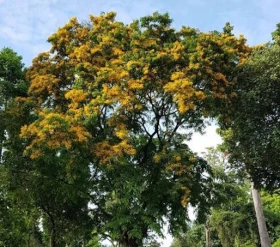
- Habit: A large, fast-growing, semi-deciduous tree reaching up to 40 m with a trunk to 2 m in diameter. The crown is broad and domed, and the branch tips are long and drooping, hanging in curtains — the character behind the Thai name ประดู่กิ่งอ่อน.
- Bark: Dark grey to almost black, fluted and buttressed at the base of older trees, splitting into shallow flaky grooves. Cut it and it releases a small amount of sap that dries blood-red — the resin known as kino or "dragon's blood."
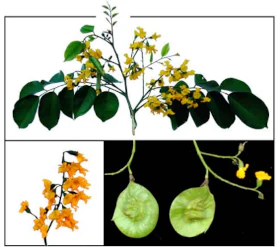
- Leaves: Odd-pinnate compound, 12–22 cm long, with 5–11 leaflets (Thai references give 6–12) arranged along the stalk. Leaflets are ovate to elliptic, 7–11 cm long, glossy green, with a drawn-out pointed (acuminate) tip.
⚠️ A common Thai error: some horticultural sources describe the leaf as ใบประกอบแบบขนนกสองชั้น (bipinnate). It is once-pinnate — a single row of leaflets plus a terminal one. This is what separates it at a glance from Delonix and Samanea, which really are bipinnate.
- Flowers: Small pea-shaped flowers, bright yellow to orange and fragrant, carried in panicles 6–13 cm long at the branch tips.
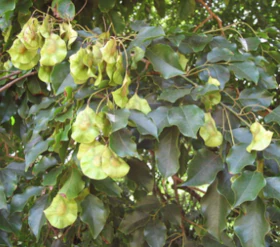
- Fruit — unmistakable: A flat, disc-shaped pod like a small flying saucer. The seed-bearing centre is 2–3 cm across and slightly domed, surrounded by a flat papery wing 4–6 cm in diameter. It holds one or two seeds and never splits open. Nothing else on a Thai campus produces this fruit.
Ecological Importance
- Nitrogen fixation: a true nodulating legume, used as a shade tree in plantations partly for the nitrogen it adds to the soil.
- Major bee plant: the fragrant flowers are an important honey source.
- Water dispersal: the flat membranous wing around the pod is a flotation device — the fruit is carried by water, which is how the species spread naturally along coasts and rivers across island Southeast Asia and the Pacific.
- Fast establishment: it grows quickly and roots readily from large cuttings, so it is used for living fences and for creating avenue shade in a few years rather than decades.
- Limits: it is not tolerant of drought or frost, and needs a genuinely humid tropical climate.
Conservation status: Endangered (IUCN). Older references still list it as Vulnerable. It has been logged heavily across its native range for its rosewood timber — this is a case where the tree is threatened because of how good its wood is.
Plant-health note: in Singapore and Malaysia, mature angsana were devastated by a vascular wilt disease in the twentieth century, which is why the species is now planted with more caution in urban avenues there. Watch campus specimens for sudden branch dieback.
Uses and Importance
Food
Not a significant food plant.
The young leaves and the flowers are reported as edible, but only as a minor or occasional food — this is not a vegetable crop. Its real contribution to the food system is as a nectar source for honey.
Medicinal — by Part and Ailment
Traditional and experimental uses. Not approved clinical treatment — do not self-medicate.
| Part | Traditionally used for / documented activity |
|---|---|
| Bark | A decoction is used for diarrhoea and dysentery, a use common among Indian and South Pacific communities; in Papua New Guinea it is used as a purgative. Also astringent, and the source of the red kino resin, historically combined with opium as a diarrhoea remedy. |
| Young leaves | Applied in Java to boils, prickly heat and ulcers; leaf infusions are also used as a shampoo. Narra leaves contain flavonoids with anti-inflammatory and anti-allergic action. |
| Root, bark and wood together | In the Philippines, a decoction or dried powder is used to support the immune system and for asthma — the subject of a granted US patent. |
| Various parts (folk medicine) | Throat ailments, mouth sores, mouth tumours, diarrhoea, boils, prickly heat, ulcers and syphilis; also listed for bladder complaints, headache, stones and thrush, and used against tumours. |
Laboratory findings: extracts of the leaves, roots and stem bark all showed wide-spectrum antibacterial activity, strongest in the butanol and methanol fractions. Isolated compounds include formononetin, isoliquiritigenin, angolensin, pterocarpin, and a 2-arylbenzofuran.
⚠️ Important safety warning: P. indicus has abortifacient properties — it has been used in the South Pacific to treat amenorrhoea. Pregnant women should not take any preparation of this plant.
Economic
- A world-class hardwood. The heartwood is red, termite-resistant and rose-scented. It is used for high-grade furniture, cabinets, sliced decorative veneer, wall panelling, flooring, cartwheels, carving, and musical instruments — including marimba keys.
- Amboyna burl, the figured wood from burls on the trunk, is among the most valuable decorative veneers in the world.
- Boat building: exceptionally durable in seawater with good resistance to marine borers. In Melanesia it is the wood of canoes, paddles and outrigger booms.
- Dye and resin: the bark yields a red dye and is a source of kino resin.
- Honey from the flowers; the leaves are also used for polishing brass and copper.
- Widely recommended as an avenue and shade tree.
Cultural
- National tree of the Philippines, where it is called narra — one of the strongest national plant symbols in Southeast Asia.
- In Thailand: ดอกประดู่, the padauk flower, is the emblem of the Royal Thai Navy. The tree is the provincial tree of Chonburi and of Phuket, the tree of Walailak University, and has been planted in royal ceremonies by King Bhumibol Adulyadej and by HRH Princess Maha Chakri Sirindhorn.
- The name ประดู่บ้าน ("house padauk") versus ประดู่ป่า ("forest padauk") records how Thai people have long distinguished the planted tree from the wild one.
Distribution & Habitat
- Origin: Native to Southeast Asia, northern Australasia and the western Pacific — Cambodia, southernmost China, East Timor, Indonesia, Malaysia, Papua New Guinea, the Philippines, the Ryukyu Islands, the Solomon Islands, Thailand and Vietnam.
- In Thailand: ประดู่บ้าน occurs in mixed deciduous forest, including in the South, and is planted nationwide as a shade and avenue tree.
- Present range: Now planted throughout the humid tropics as an ornamental and plantation shade tree.
- Habitat preferences: Humid lowland tropics with reliable rainfall. It accepts a range of soils but is intolerant of drought and frost — a contrast with the dry-country trees elsewhere in this series.
Flowering & Fruiting
Flowering: Thai records give the main flowering period as April to August.
The remarkable part — synchronised mass flowering. Narra does not flower gradually. A heavy rain triggers bud development, and every tree in a district opens together a few days later, turning whole avenues yellow at once. The display then collapses within about a day, carpeting the ground in yellow petals. A single tree may repeat this two or three times in a season.
Pollination: By bees, drawn to the fragrant flowers.
Fruiting: The winged disc-pods develop over several months, drying to pale brown. They are indehiscent — they never split — and fall whole to be carried away by water.
Propagation: By seed, and very readily from large stem cuttings, which is how instant avenues are established.
Did You Know?
- The whole district flowers on the same day. Narra flowering is triggered by rain and is synchronised across every tree in an area — then the flowers fall within about a day, leaving a yellow carpet on the road. If you want to photograph it, you have roughly twenty-four hours' notice, and the notice is a rainstorm.
- The fruit is a flying saucer built for water travel. The flat papery wing around the seed case is a flotation ring, not a wind vane. That is how a single tree species came to occupy coastlines from Thailand to the Solomon Islands.
- It is Endangered because its wood is too good. Rose-scented, termite-proof, seawater-resistant and beautifully figured, narra has been logged across its native range to the point that Pterocarpus indicus is now assessed as Endangered — while simultaneously serving as the national tree of the Philippines and the emblem of the Royal Thai Navy.
References
- Wikipedia — Pterocarpus indicus (taxonomy, native range, IUCN status, uses, leaf flavonoids).
- Kew Science, Plants of the World Online — Pterocarpus indicus Willd. powo.science.kew.org
- IUCN Red List — Pterocarpus indicus. iucnredlist.org/species/33241/2835450
- GlobinMed — Pterocarpus indicus: botanical description, traditional uses, antibacterial screening, isolated compounds, abortifacient caution. globinmed.com/safety/pterocarpus-indicus
- National Tropical Botanical Garden (NTBG) plant database — Pterocarpus indicus: Javanese leaf use, kino resin, timber and burl, honey, provincial and national tree status. ntbg.org/database/plants/detail/Pterocarpus-indicus
- Plants For A Future (PFAF) — Pterocarpus indicus: nitrogen fixation, edible leaves and flowers, medicinal summary, timber uses, red dye. pfaf.org
- Elevitch, C.R. & Thomson, L.A.J. Pterocarpus indicus (narra). Species Profiles for Pacific Island Agroforestry. agroforestry.net/tti/Pterocarpus-narra.pdf
- Duke, J.A. — Purdue University Center for New Crops and Plant Products: Pterocarpus indicus.
- US Patent 6,998,142 — Composition and method for the prevention and treatment of asthma (narra root, bark and wood).
- Thai Wikipedia — ประดู่ (Pterocarpus macrocarpus) and the ประดู่ป่า / ประดู่บ้าน distinction.
- Digital Agriculture Database (data.addrun.org) — ประดู่บ้าน Pterocarpus indicus: Thai description, flowering season, pod shape.
- Walailak University Archives — ประดู่: Royal Thai Navy emblem, provincial tree of Phuket, royal plantings.
- Panmai.com — ต้นไม้ประจำจังหวัดภูเก็ต: ต้นประดู่บ้าน, Thai regional names.