
AIU Campus Plant Profile
Traveller's Tree
Ravenala madagascariensis Sonn.
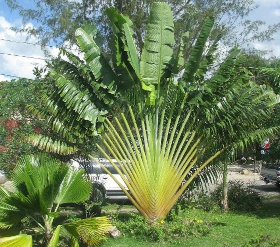
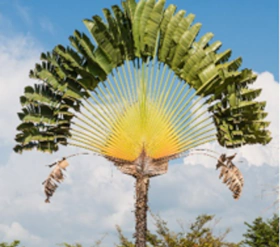
Note on spelling: the correct species epithet is madagascariensis, not "madagascarensis."
Taxonomy note: Ravenala was long considered a single-species genus. In 2021, five new species were formally described, and the name R. madagascariensis was fixed to the populations of Madagascar's east coast.
How to Identify
- Habit: An evergreen, medium to large tree-like plant, 10–20 m tall, with a fan-shaped crown spreading 3–6 m. It suckers from the base, so mature clumps often carry several stems.
- Trunk: Straight, round, and brown, ringed with short, closely spaced nodes — the reason people mistake it for a palm. It is not woody in the way a true tree is; the "trunk" is built from old leaf bases and stem tissue.
- Leaves — the defining feature: Enormous, oblong, banana-like blades on very long petioles, arranged distichously — strictly alternating left and right in a single flat plane, producing the unmistakable giant fan. A mature plant carries 30 to 45 leaves, and a leaf with its petiole can reach 11 m. The petiole bases wrap the stem and form cups that hold rainwater.
- Flowers: Borne in inflorescences from the leaf axils, with stiff, boat-shaped bracts. The flowers themselves are white and comparatively modest — much less showy than those of its bird-of-paradise relatives — and are enclosed in green bracts. Nectar production is copious, peaking at midnight.
- Fruit: A woody brown capsule that dries and splits open to reveal seeds wrapped in a vivid, fuzzy blue aril — one of the most striking sights in the plant world and an instant confirmation of identity.
Ecological Importance
Lemur pollination — an archaic coevolutionary system. In Madagascar this plant is pollinated predominantly by lemurs, especially the ruffed lemur (Varecia variegata) and the black lemur (Eulemur macaco). The lemur must wedge its face into the flower to reach the nectar chamber, contacting the stigma in the process. Lemurs in turn depend heavily on this nectar at certain times of year — a genuine two-way dependence between two Madagascan endemics.
The blue seed is aimed at lemurs. The edible blue aril exists to attract dispersers. Lemurs see only shades of blue and green, so the colour is effectively a signal tuned to their vision.
Outside its native range the flowers are worked by large fruit bats (Pteropus, Macroglossus) and by honeyeater birds — different animals filling the same role.
Water-holding leaf bases (phytotelmata): Each hollow leaf base can hold roughly a litre of rainwater, creating small aquatic microhabitats used by insects and other small animals.
Campus relevance — worth flagging to your environmental groups. Those same water-filled leaf bases are documented mosquito breeding sites. On a campus where dengue control matters, a stand of Ravenala deserves inspection during the rains along with the more obvious containers and drains.
Invasive potential. Research notes that because Ravenala can reproduce vegetatively and is at least a facultative self-pollinator, it can set seed outside its natural range without its co-evolved pollinator — which could allow the species to assume pest status in parts of the tropics where it is planted as an ornamental. Remove suckers from beds where you don't want it spreading.
Uses and Importance
Food
| Part | Use |
|---|---|
| Seed aril (the blue coating) | Edible raw — but reported as tasteless. |
| Trunk heart | Eaten in Madagascar, boiled, as a food source. |
| Trunk sap | Sugar can be extracted from it. |
| Rainwater in the leaf bases | Drunk by travellers in emergency — the origin of the name — but this water is often undrinkable, contaminated with mosquito larvae and plant debris. |
Medicinal
Note for honesty on the sign: the ethnobotanical literature attributes these uses to the plant rather than assigning each ailment to a specific part, so part-by-part data is thinner here than for the trees in this series.
Traditional phytotherapeutic use covers: coughs, stomachache, urine retention, diabetes, diarrhoea, oedema, kidney stones, and hypertension.
Research findings: studies report antioxidant, antimicrobial, enzyme-inhibition, antidiabetic, and cytotoxic effects, both in vitro and in vivo. The plant is described as being used for medical and cosmetic purposes internationally, with recent interest focused on the unusually chemically stable blue pigment of the aril.
Economic
- Ornamental — by far the main commercial value; one of the signature architectural plants of tropical landscaping worldwide.
- Construction — trunks are used for building dwellings in Madagascar; leaves for thatch and walls.
- Handicraft — Thai sources note that the stiff flower bracts are used to make ornaments and various handicrafts; leaves and stems also make tools and utensils.
- Pigment — the stable blue aril pigment is under investigation for cosmetic and medical applications.
Cultural
- The traveller's tree is Madagascar's emblematic plant — the country's most recognisable botanical symbol, described in the scientific literature as a "flagship plant genus."
- In Thailand one of its common names is กล้วยศาสนา, "religion banana," reflecting its frequent planting at temples and religious buildings.
- Its shape has made it a fixture of hotel, resort, and institutional landscaping across the tropics, where a single specimen is used as a focal point.
Distribution & Habitat
- Origin: Endemic to Madagascar. Following the 2021 revision, the name R. madagascariensis applies specifically to populations of the eastern coast, with the reference specimen from the marshy Fort-Dauphin area in the south.
- Native habitat: Rainforest, forest margins, and marshy ground; it behaves as a pioneer, colonising disturbed and cleared land readily.
- Present range: Widely cultivated throughout the tropics and subtropics as an ornamental, including all regions of Thailand.
- Growing conditions: Thai horticultural sources give it as tolerant of any soil type, needing medium to high water and full sun. It is not a drought plant — it wants moisture — and it is not frost-hardy.
- Conservation status: Least Concern (IUCN). The plant itself is secure; its lemur pollinators are not, which is the more important conservation story.
Flowering & Fruiting
Flowering: Intermittently throughout the year rather than in one defined season. Flowers emerge from the leaf axils inside stiff boat-shaped bracts.
Nectar timing: Production is copious and peaks at midnight — the signature of a plant pollinated by night-active animals such as lemurs and bats.
Breeding system: At least a facultative self-pollinator, so it can set seed even without its natural pollinators.
Fruiting: The capsule matures, dries to brown, then splits into valves to expose the blue-arilled seeds.
Propagation: By seed and by division of the basal suckers — the easier and faster route, and the reason nursery plants are cheap and widely available.
Did You Know?
- It is not a palm at all. Despite "traveller's palm," it belongs to Strelitziaceae, making it a close relative of the bird of paradise and a more distant one of the banana. The palm-like trunk and the fan of leaves are convergent appearances, not shared ancestry — a good teaching example of why common names mislead and scientific names do not.
- Its blue seeds may be the most remarkable colour in the plant kingdom. True blue is exceptionally rare in nature. The Ravenala aril is not only vividly blue but chemically unusually stable, and it appears to have evolved that way because lemurs perceive blue and green — the plant is advertising directly to the only animals that will carry its seeds.
- Both explanations of "traveller's" are shakier than they sound. One says travellers drank the rainwater held in the leaf bases — true, but the water is usually foul with mosquito larvae and debris. The other says the fan aligns east–west as a rough compass — a claim repeated everywhere, yet without supporting data behind it.
References
- Haevermans, T. et al. (2021). Description of five new species of the Madagascan flagship plant genus Ravenala (Strelitziaceae). PhytoKeys / PMC8578647.
- Kress, W.J., Schatz, G.E., Andrianifahanana, M. & Morland, H.S. (1994). Pollination of Ravenala madagascariensis (Strelitziaceae) by lemurs in Madagascar: evidence for an archaic coevolutionary system? American Journal of Botany, 81: 542–551.
- Birkinshaw, C.R. & Colquhoun, I.C. (1998). Pollination of Ravenala madagascariensis and Parkia madagascariensis by Eulemur macaco in Madagascar. Folia Primatologica. PMID: 9751827.
- Sussman, R.W. & Raven, P.H. (1978). Pollination by lemurs and marsupials: an archaic coevolutionary system. Science, 200: 731–736.
- (2025). Regarding the nature of the blue pigment in arils of Ravenala madagascariensis Sonn. (Strelitziaceae). PMC11983200.
- PROTA — Plant Resources of Tropical Africa: Ravenala madagascariensis (nectar timing, pollinators, food and material uses, invasive potential), via Useful Tropical Plants. tropical.theferns.info
- Wikipedia — Ravenala madagascariensis (leaf number and dimensions, name origins, status).
- Royal Park Rajapruek plant database — กล้วยพัด. rpplant.royalparkrajapruek.org/Display/details_fn/5125
- Queen Sirikit Botanic Garden (องค์การสวนพฤกษศาสตร์) BGO Plant Database — กล้วยพัด.
- Baan Lae Suan (บ้านและสวน) and data.addrun.org — กล้วยพัด: dimensions, cultivation, handicraft use of the bracts.