
AIU Campus Plant Profile
Bismarck Palm
Bismarckia nobilis Hildebr. & H.Wendl.
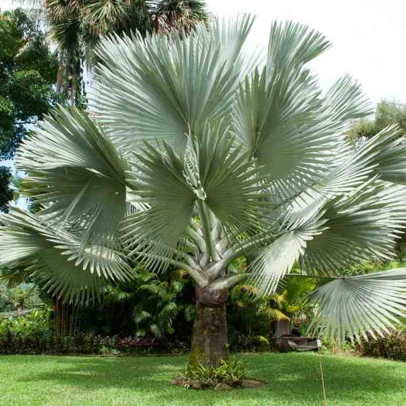
⚠ A correction to check before you print. Several travel and tourism websites describe the Bismarck palm as "critically endangered." This is wrong. The IUCN assesses it as Least Concern, and palm references describe it as widespread and very common across western and northern Madagascar. Please don't let that claim reach the sign.
How to Identify
- Habit: A massive solitary fan palm — one trunk, never clumping. Above 25 m in its native grassland, but usually no taller than about 12 m in cultivation.
- Colour is the identification. The common form has stiff, waxy, silver-blue leaves, visible from across a campus. No other large palm commonly planted in Thailand is this colour. A green-leaved form also exists and is easy to confuse with other fan palms.
- Trunk: Grey to tan, 30–45 cm in diameter, slightly bulging at the base and marked with ring-like scars from old leaf bases. Old leaf bases are shed cleanly except on the youngest part of the trunk.
- Leaves: Nearly circular and enormous — over 3 m wide at maturity — divided about a third of the way in into 20 or more stiff, folded segments that are themselves split at the tips.
- Costapalmate: Look where the leaf stalk meets the blade. The stalk continues a short way into the blade as a midrib (the costa), so the leaf is slightly V-shaped rather than flat — halfway between a fan leaf and a feather leaf.
- Petioles: Stout, 2–3 m long, slightly armed along the margins, and coated in white wax and cinnamon-coloured scales that rub off.
- Crown: Nearly spherical, up to about 7.5 m wide and 6 m tall on a mature palm. This is a tree that needs room.
- Flowers and fruit: Small, creamy flowers on long hanging inflorescences among the leaves. Fruits are olive-brown, about 3–4 cm, and are only produced on female trees.
Telling it apart from other fan palms on campus
| Palm | Leaf colour and texture | Trunk |
|---|---|---|
| Bismarckia nobilis | Stiff, waxy silver-blue (or green form); segments rigid | Single, grey-tan, clean with leaf-scar rings |
| ตาล — Borassus flabellifer | Dark green, leathery; the sugar-palm familiar across Thailand | Single, dark, often retaining old leaf bases |
| Livistona species | Green, glossy; segment tips droop like a fringe | Single, slender; petioles strongly toothed |
Ecological Importance
- A palm of open grassland, not forest. It grows on the open grasslands, plateaux and plains of western and northern Madagascar, in large numbers — often as the only tree in a landscape of regularly burnt palm savanna.
- Built to survive fire. Where the grass burns regularly, the Bismarck palm survives while other trees do not. Its growing point is protected high inside the trunk, and the grassland fires that kill young trees of other species leave it standing.
- The silver colour is an adaptation. The white wax on the leaves is thought to reflect strong sunlight and reduce water loss — useful in an exposed, hot, seasonally dry habitat with no shade.
- Tolerant of water as well as drought. It is sometimes found in seasonally flooded areas, and only rarely grows mixed with the other Madagascan fan palm, Hyphaene.
- Wildlife: flowers and fruits are produced in the hotter months and are used by insects, birds and small mammals.
- Conservation status: Least Concern (IUCN). Widespread and very common in its native range — see the correction note above.
A teaching point about grassland. Much of western Madagascar's palm savanna is shaped by repeated burning. The Bismarck palm's abundance there is partly a sign of what that fire regime has removed. "Very common" is not always the same as "ecologically healthy" — a useful contrast with the forest species elsewhere in this series.
Uses and Importance
Food
- Sago from the pith. In Madagascar the pith of the trunk is eaten as a slightly bitter sago — a starch food, as with the sago palms of Southeast Asia.
- The fruit is not a recorded food. Unlike its Thai relative ตาล, whose fruit and sap are central to Thai cooking, the Bismarck palm has no recorded fruit or sugar use.
- Harvesting the pith kills the palm, since the whole trunk is opened to extract it. This is a food of necessity rather than a crop.
Medicinal — by Part and Ailment
⚠ There is essentially nothing to report. No species-specific medicinal use of Bismarckia nobilis was found in the sources consulted. Its traditional value in Madagascar is as a building material and a starch food.
| Plant Part | What is recorded |
|---|---|
| All parts | No reliable, species-specific traditional or clinical medicinal use found. |
| A caution | Medicinal claims made for other palms — including ตาล and the coconut — should not be transferred to this species. |
As with the Cook pine: a sign that says plainly "no medicinal tradition is recorded for this palm" is better than one filled with borrowed claims.
Economic
- Building material in Madagascar. The trunk is hollowed out and flattened to make planks and partition walls — a significant local use in the north-west, where timber is scarce.
- Thatch and weaving. The leaves are used for roofing, and for baskets and mats.
- A prized ornamental worldwide. Outside Madagascar it is valued as a specimen palm for the drier tropics and subtropics — in Florida, southern China, Hong Kong, Singapore, Australia and Thailand. The silver form commands the higher price.
- Slow to establish and hard to move. Young plants send down a deep root before much top growth appears and resent transplanting. Nurseries sell them in deep containers for this reason, and field-grown specimens are expensive.
Cultural
- In Madagascar, satrana is a working tree. Its local names and its uses for walls, roofs and baskets tie it to everyday rural life in the north and west of the island.
- In Thailand it is a status ornamental. Its size and silver colour make it a favourite for resort entrances, hotel driveways, government buildings and upmarket housing developments.
- It carries a European politician's name. Very few plants are named after politicians rather than botanists or explorers — see Did You Know.
Distribution & Habitat
- Native range: endemic to western and northern Madagascar.
- Habitat: open grassland, plateaux and plains on all terrains, especially on the west coast — regularly burnt palm savanna, sometimes seasonally flooded ground. Occasionally planted in eastern Madagascar.
- Biome: the seasonally dry tropics — a pronounced dry season, which suits the Thai climate well.
- Cultivated widely across the tropics and subtropics, including Florida, southern China, Hong Kong, Singapore, Australia, Mayotte, Colombia and Thailand.
- Site requirements: full sun, good drainage, and plenty of space for the crown. Tolerant of drought once established. The silver form tolerates cool weather better than the green, which prefers fully tropical conditions.
- In Thailand: planted only. No naturalised populations recorded.
Flowering & Fruiting
Male and female trees are separate. This palm is dioecious. Only female trees produce fruit, and they need pollen from a male tree to make viable seed. A single Bismarck palm on campus will never produce seedlings — and one that does fruit tells you there is a male somewhere within pollinating distance.
- Inflorescences: long, arching and branched, up to about 1.5 m, hanging from among the leaves. Male inflorescences carry catkin-like flowering branches; female ones are fewer and bear larger flowers.
- Flowers: small, creamy-white and inconspicuous, produced in the hotter months.
- Fruit: an olive-brown drupe about 3–4 cm across, containing a single seed.
- Age at first flowering: planted palms take a number of years to reach flowering size. Young palms show no sign of whether they are male or female until they flower.
- Worth recording on campus: which of your palms are male and which are female, and when each flowers. That sex record is basic data a campus inventory rarely has, and it takes only one look at an inflorescence to collect.
Did You Know?
- One genus, one species. Bismarckia is monotypic — Bismarckia nobilis is the only species in its genus anywhere in the world.
- Named after a chancellor. The genus honours Otto von Bismarck, the first chancellor of the German Empire; nobilis is Latin for "noble." Naming a plant after a politician is rare in botany.
- A cousin of the sugar palm. It belongs to the same tribe, Borasseae, as ตาล (Borassus flabellifer) — so its closest familiar relative in Thailand is the palm of น้ำตาลโตนด.
- Silver by design. The blue-white colour is a coat of wax on the leaf, and it rubs off on your fingers. Try it on a low leaf stalk.
- Fire made it common. On regularly burnt Madagascan grassland it is often the only tree left standing — abundance that says as much about the fire as about the palm.
- The leaf is not quite a fan. Its costapalmate leaves have a short midrib running into the blade, which bends each leaf into a shallow V.
- "Critically endangered" is a myth. Despite what several websites say, the IUCN lists it as Least Concern.
References
- POWO (2024). Plants of the World Online — Bismarckia nobilis Hildebr. & H.Wendl. Royal Botanic Gardens, Kew.
- Govaerts, R. & Dransfield, J. (2005). World Checklist of Palms. Royal Botanic Gardens, Kew.
- Dransfield, J. & Beentje, H. (1995). The Palms of Madagascar. Royal Botanic Gardens, Kew & International Palm Society.
- Dransfield, J. et al. (2008). Genera Palmarum: The Evolution and Classification of Palms. Kew Publishing.
- IUCN Red List of Threatened Species — Satrana, Bismarckia nobilis (assessment 195991).
- Palmpedia — Bismarckia nobilis (habitat, uses and conservation notes).
- Missouri Botanical Garden Plant Finder — Bismarckia nobilis.
- Hong Kong Greening, Landscape & Tree Management Section — Tree label no. 109, Bismarck Palm.
- Mitchell, R. E. (2012). Bismarck palms failing in southwest Florida. Proceedings of the Florida State Horticultural Society 125: 355–356.
- Smitinand, T. (2014). Thai Plant Names, revised edition. Forest Herbarium, DNP, Bangkok.
Note for the Sign
Two facts earn the space on this sign. First, the wax: invite passers-by to touch a low leaf stalk and see the silver come off on their fingers — a demonstration anyone can do. Second, the sexes: if you can determine whether your palm is male or female, print it. "This is a female Bismarck palm" teaches dioecy more memorably than any definition.
And please leave out "critically endangered." It is a widespread claim, and it is not true.