
AIU Campus Plant Profile
Satinleaf
Chrysophyllum oliviforme L.
How to Identify
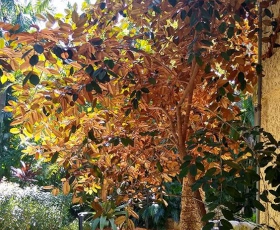
- Habit: Evergreen and highly variable — often a shrub or small tree of 3–5 m, reaching 10 m in good conditions and occasionally 15 m or more. The crown is narrow in shade and spreads in full sun, and the tree is generally open rather than dense.
- Trunk: Slender, rarely more than 30 cm in diameter, often straight, and sometimes arising from the roots after damage. Bark is thin, light reddish-brown, rough and scaly — attractive in its own right.
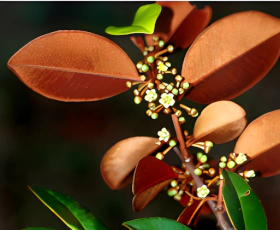
- Leaves — the whole point of this tree: Alternate, simple, entire, elliptic to oblong, 5–15 cm long and 2–5 cm wide, stiff and leathery. The upper surface is dark green and hairless; the lower surface is densely covered in reddish-brown felted hairs.
- The field test: Turn a leaf over, then watch the tree in a breeze. The contrast between glossy dark green above and glowing copper beneath produces a two-toned shimmer as the wind moves the foliage. Nothing else on a Thai campus does this.
- Young growth: Young stems, leaf undersides and flower stalks are all densely covered in reddish-brown hairs.
- Latex: Cut a twig or a leaf and a milky white sap appears, as in all Sapotaceae.
- Flowers: Small and easily missed. Borne in axillary clusters of two to nine, with five brown-hairy sepals and five fused white petals. Creamy-white to yellowish, faintly fragrant.
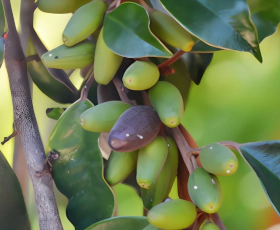
- Fruit: An olive-shaped berry 1.5–2 cm long, green while developing and dark purple to nearly black when ripe, with a gummy skin and whitish flesh around the seed or seeds.
Don't confuse it with its close relative the star apple (Chrysophyllum cainito), which has the same copper leaf undersides but fruit five to ten times larger and round rather than olive-shaped.
Ecological Importance
- A wildlife food tree. The small purple berries are particularly valued by migratory birds. In Florida hammocks, mockingbirds, catbirds and jays are the main dispersers, and the crop is taken quickly once ripe.
- Native hammock species. In its own range it is a component of tropical hardwood hammocks and pine rocklands, regenerating in gaps and along margins rather than under deep closed canopy.
- Tolerant of poor, thin soils. It grows on limestone outcrops and sandy soils and is drought tolerant once established — traits worth noting for campus planting on compacted or shallow ground.
- Hurricane and wind resistant, which is why it is recommended for exposed landscape positions in Florida.
- Conservation status is a study in contrasts. Florida lists satinleaf as a threatened species because of hammock loss to development, yet globally the IUCN assesses it as Least Concern since it remains common across the Caribbean.
⚠ An honest caution for a campus planting. Outside its native range this species can escape cultivation. It is sparingly naturalised in south-eastern Queensland, where it is regarded as a potential weed of riparian vegetation, rainforest gaps and margins, and urban bushland. It has also become invasive in Hawaii and naturalised in French Polynesia, where planting is discouraged. There is no record of it naturalising in Thailand — but bird-dispersed fruit in a wet tropical climate is exactly the combination that produced the Queensland problem. If your project includes a monitoring component, this tree is worth watching for seedlings beyond the planted area.
Uses and Importance
Food
- The fruits are edible — sweet but small, with a thin layer of flesh around the seed and a gummy skin. They are eaten fresh rather than processed.
- The tree is sometimes cultivated elsewhere in the tropics, especially in the Caribbean, for its edible fruit.
- It is a minor local fruit, never a commercial crop. The name "damson plum" reflects a resemblance in size and colour, not any botanical relationship to true plums.
Medicinal — by Part and Ailment
⚠ Read this section carefully. The ethnomedicinal record for this species is thin. Most published medicinal work on the genus concerns the star apple (C. cainito), and those findings should NOT be transferred to satinleaf on a sign or in a report.
| Plant Part | What is actually documented |
|---|---|
| Whole plant / unspecified | Used in the Lucayan Archipelago (the Bahamas and Turks and Caicos) to treat circulatory problems. This is the clearest traditional use on record. |
| Leaf | A 2019 study found that methanol leaf extracts reduced liver damage in rats given carbon tetrachloride, restoring altered cholesterol, triglyceride and liver-enzyme levels. Total phenolic content exceeded that of C. cainito. This is laboratory research, not established practice. |
| Bark, root, fruit, seed | No reliable, species-specific traditional use found in the sources consulted. Claims attributed to these parts online are almost certainly borrowed from C. cainito. |
The honest framing for a campus sign: a tree whose medicinal reputation belongs mostly to its famous cousin, and whose own chemistry is only now being examined.
Economic
- Ornamental horticulture is the real economic use. It is grown in the horticultural trade specifically for the contrast between the upper and lower leaf surfaces.
- In Florida landscaping it serves as a freestanding lawn specimen, a component of shrubbery borders, and a candidate street or parking-lot tree.
- Slow-growing and slow to establish, which limits nursery volume. Small seedlings transplant well, but larger stock is difficult.
- Timber is hard and heavy, but the trunk is too slender for commercial use; wood is used locally for small items and posts only.
Cultural
- In the Bahamas and the Spanish Caribbean the tree carries a cluster of vernacular names — caimitillo ("little star apple"), teta de burra, macanabo — that mark it as a familiar bush tree rather than a cultivated one.
- In Florida it has become a signature species of the native-plant landscaping movement, planted deliberately as an alternative to imported ornamentals and as a small-scale act of hammock restoration.
- It has no cultural history in Thailand. On this campus it is a teaching specimen and an ornamental — which is itself worth saying on the sign, since students should know which trees around them are native and which are not.
Distribution & Habitat
- Native range: the Florida peninsula from Brevard County on the east coast and Collier County on the west coast southwards; the West Indies, including the Bahamas, Cuba, Hispaniola, Jamaica and Puerto Rico; Mexico in San Luis Potosí and Chiapas; also Belize and the Turks and Caicos.
- Two subspecies are recognised. Subspecies angustifolium is endemic to Hispaniola; subspecies oliviforme covers the rest of the range.
- Habitat: hammocks and pine rocklands — coastal hammocks, limestone outcrops, and the sandy soils of tropical hardwood forest.
- Soil and light: well-drained soils, full sun to part shade. Moderately salt-wind tolerant but poorly tolerant of salt water at the roots, so it belongs behind the front line of a coastal planting.
- Climate limit: it can be severely damaged at 0°C and below, restricting it to USDA zones 10B–11.
- Introduced elsewhere as an ornamental across the tropics, including Southeast Asia. In Thailand it is planted only, with no naturalised populations recorded.
Flowering & Fruiting
- Phenology is climate-dependent and unusually extended. In Florida the species is recorded as flowering across all twelve months, with fruit ripening mostly in spring.
- In Puerto Rico, a more equatorial climate closer to Thailand's, flowering runs from July to October with fruit maturing in February.
- What to expect at Muak Lek: this is worth having students record rather than assume. A tropical monsoon climate with a pronounced dry season will likely concentrate flowering in the warm wet months and fruiting toward the cool season — but nobody has published the phenology for planted trees in Thailand, which makes your campus specimens genuinely worth monitoring.
- Fruit set is usually light on isolated trees. The flowers are hermaphroditic, so a single tree can set fruit, but crops are larger where several trees grow together.
Did You Know?
- The name says it twice. Chrysophyllum is Greek chrysos (gold) + phyllon (leaf) — golden leaf, for those coppery undersides. oliviforme means olive-shaped, for the fruit. Genus and species between them describe the two things you notice first.
- Linnaeus named it. It appeared in the tenth edition of his Systema Naturae in 1759 — one of the original species of formal botanical nomenclature.
- Its closest relative is the star apple. DNA and morphological work places C. oliviforme nearest to C. cainito, the caimito of Caribbean markets. Essentially the same tree, with the fruit shrunk to a tenth of the size.
- It is a sapodilla relative. Sapotaceae is the family of ละมุด — so the milky latex from a cut satinleaf twig is chemically kin to the chicle once used for chewing gum.
- Threatened and thriving at the same time. Protected by law in Florida, listed as Least Concern by the IUCN, and a declared weed risk in Queensland. Three jurisdictions, three verdicts, one tree — a useful lesson for students about what "endangered" actually measures.
- The wild cousin outperformed the cultivated one. In the liver-protection research, total phenolic content in the satinleaf extract exceeded that of the star apple.
References
- POWO (2024). Plants of the World Online — Chrysophyllum oliviforme L. Royal Botanic Gardens, Kew.
- Pennington, T. D. (1990). Sapotaceae. Flora Neotropica Monograph 52. New York Botanical Garden.
- Flora of North America, Vol. 8 — Chrysophyllum oliviforme subsp. oliviforme.
- Weakley, A. S. et al. Flora of the Southeastern United States. North Carolina Botanical Garden.
- Little, E. L. & Wadsworth, F. H. (1964). Common Trees of Puerto Rico and the Virgin Islands. USDA Forest Service.
- Adams, C. D. (1972). Flowering Plants of Jamaica. University of the West Indies.
- Gilman, E. F. & Watson, D. G. Chrysophyllum oliviforme: Satinleaf. UF/IFAS Extension ENH325/ST166.
- Leon Levy Native Plant Preserve, Bahamas — species listing for Chrysophyllum oliviforme.
- Elsayed, H. E. et al. (2019). Phenolic constituents of Chrysophyllum oliviforme L. leaf down-regulate TGF-β expression and ameliorate CCl₄-induced liver fibrosis. Molecules.
- Environmental Weeds of Australia / Lucid Key — Chrysophyllum oliviforme subsp. oliviforme.
- BGCI & IUCN SSC Global Tree Specialist Group — IUCN Red List assessment.
Note for the Sign
Since there is no Thai name for satinleaf, that line on the sign needs a decision rather than a fact. The options are a transliteration, a descriptive phrase, or simply the scientific and English names alone. For an exotic ornamental on a teaching campus, the last option has something to recommend it: let the sign say plainly that this tree has no Thai name because it does not grow here naturally.