
AIU Campus Plant Profile
Yellow Silk Cotton Tree
Cochlospermum religiosum (L.) Alston
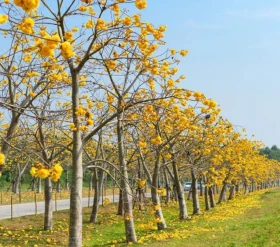
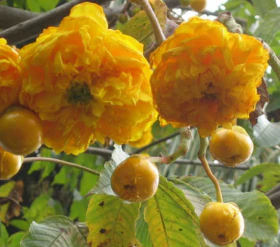
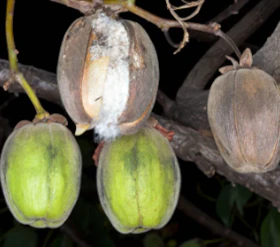
Note: In Thailand the names ฝ้ายคำ and สุพรรณิการ์ are used interchangeably, but they properly refer to two different species. The generally accepted distinction: ฝ้ายคำ = C. religiosum, with single flowers of five petals that open one at a time; สุพรรณิการ์ = C. regium from South America, which includes double-flowered forms and whose flowers open all together. Thai sources contradict each other on this, so identify your campus tree by the flower, not by the label.
How to Identify
- Habit: A small to medium deciduous tree, 7–15 m tall, with crooked, twisting branches and a sparse, open crown.
- Bark: Smooth and ash-grey to pale brown. When cut it exudes a gum that dries into hard, translucent lumps — this is the commercially traded “gum katira.”
- Leaves: Broadly heart-shaped in outline, palmately divided into five-pointed lobes, with a notched leaf base and wavy margins. They look somewhat like a cotton or maple leaf, which is where “silk cotton” comes from.
- Flowers: Large, brilliant golden-yellow, cup-shaped, with five thin, crinkled petals and a dense boss of yellow stamens. The flowers are lightly scented and open on bare branches — the tree drops nearly all its leaves before blooming, so the display is pure yellow against grey wood.
- Fruit: An obovoid capsule that splits into 3–5 valves when ripe. Inside are brown, kidney- or bean-shaped seeds each wrapped in white cotton-like floss — the “silk cotton” of the common name.
Ecological Importance
- Dry-forest specialist: Native to dry deciduous forest, it survives the long dry season by shedding its leaves entirely, then flowering while dormant — a textbook drought-deciduous strategy worth pointing out to students.
- Dry-season nectar: Its huge yellow flowers open at the leanest time of year, when few other trees are in bloom, and draw bees and other pollinators.
- Wind dispersal: The cotton-like floss carries seeds on the wind from the splitting capsules.
- Soil and slope: Tolerant of poor, rocky, well-drained ground; useful for dry banks and degraded sites.
- Conservation concern: The species is regarded as threatened because of overexploitation — mainly from destructive tapping of the trunk for gum. A campus tree is a small conservation contribution.
Uses and Importance
Food
- Fruits are edible.
- Young leaves and shoots are eaten as a vegetable in parts of India.
- Gum has commercial food value in confectionery and ice-cream manufacture.
Medicinal — By Part and Ailment
Traditional uses plus laboratory findings. Not a clinically approved treatment — do not self-medicate.
| Part | Traditionally Used For |
|---|---|
| Gum (from the stem bark; “gum katira” / “kondagogu gum”) — the most important part | Pharyngitis and sore throat, dysentery, diarrhea, asthma, eye complaints, and stomachache. Described as sweetish, cooling and sedative, and valued as an ingredient in cough medicine. Also studied for wound-healing activity |
| Stem bark, root and leaves | Cough, bone fracture, ulcer, jaundice, itching, asthma, diarrhea, dysentery, tuberculosis, syphilis, sore throat, gonorrhea, and piles |
| Young leaves | Used as a cooling remedy and for washing the hair (dandruff) |
| Dried leaves and flowers | Reported to be stimulant |
| Whole plant | Used as a sedative, and traditionally to improve complexion and memory |
Key research findings
- Demonstrated antibacterial, antifungal, insecticidal, and antioxidant activity.
- A flavonoid isolated from the leaves protected rat lenses from sodium selenite-induced cataract formation in vitro.
- The gum shows promising bioremediation capacity for removing heavy metals from water.
Economic
The tree is grown chiefly for the ornamental trade and for two non-timber forest products — gum and floss.
- Gum katira is used in pharmaceuticals, confectionery, adhesive pastes, and cigar manufacture, and serves as a substitute for gum tragacanth in industry; mixed with gum arabic it makes a water-based adhesive.
- The seed floss is an inferior substitute for kapok (stuffing, caulking).
- The seeds contain 14–15% of a non-drying oil suitable for soap-making, and the residual seed-cake works as cattle feed or manure.
- The bark yields a cordage fibre; the wood is soft, light, and of little commercial value.
Cultural
- The species epithet religiosum means “sacred” — given because the flowers are used as temple offerings.
- In Theravada Buddhism, the tree is held to be the Bodhi tree under which the nineteenth Buddha, Siddhartha, attained enlightenment. It is known as කිනිහිරියා (Kinihiriya) in Sri Lanka.
- In Thailand, it is the provincial flower of several provinces, including Saraburi, Nakhon Nayok, Suphan Buri, Uthai Thani, and Buriram. It is also the official tree of Ramkhamhaeng University, bestowed by HRH Princess Maha Chakri Sirindhorn, where its meaning is given as sanctity and high value.
Distribution & Habitat
- Origin: Native to the Indian subcontinent and tropical Southeast Asia, where it grows naturally in dry deciduous forest.
- Present range: Widely planted across the tropics as an ornamental. In Thailand it is grown in every region as a flowering ornamental.
- Habitat preferences: Full, strong sun and loose, well-drained soil. It is highly drought-tolerant and suited to rocky, dry ground; it does not tolerate waterlogging. Saraburi's dry season suits it well — the tree needs that dry period to flower properly.
Flowering & Fruiting
Leaf fall first: The tree sheds its leaves before flowering, which is what produces the striking bare-branch display.
Flowering: Mainly the cool-dry to hot-dry season, roughly December to March. In C. religiosum, the flowers open one at a time over an extended period, rather than all at once — so the tree carries scattered blooms across many weeks instead of a single simultaneous flush.
Fruiting: Capsules ripen around March, splitting into 3–5 valves to release the floss-wrapped seeds. Propagation is by seed and by cuttings.
Did You Know?
- Its scientific name means “sacred” — and the reason is literal. Religiosum was given because the golden flowers are offered at temples. Theravada tradition also names it as the tree of enlightenment for the nineteenth Buddha, which is why it is planted at temples across Sri Lanka and mainland Southeast Asia.
- The tree bleeds a gum that cleans polluted water. Gum katira from the trunk is best known as a tragacanth substitute in medicine, sweets, and ice cream — but research has shown it is also an effective binder of heavy metals, giving a village forest product a genuine modern environmental application.
- It is Saraburi's provincial flower — and the reason two Thai names get muddled. ฝ้ายคำ and สุพรรณิการ์ are two different species that look nearly identical. The reliable field test is the flower: C. religiosum has a single row of five petals opening one bloom at a time, while the true สุพรรณิการ์ (C. regium) often has densely doubled petals and opens its flowers all together.
References
- Prashith Kekuda, T.R., Smruthi, B.S., Saima Banu & Swathi, B.G. (2019). A comprehensive review on the ethnobotanical uses and pharmacological activities of Cochlospermum religiosum (L.) Alston (Bixaceae). Journal of Pharmacognosy and Phytochemistry / Plants Journal, 7(3).
- Ballard, H.E. et al. (2018). Comparing medicinal uses of Cochlospermaceae throughout its geographic range with insights from molecular phylogenetics. Diversity, 10(4): 123. doi:10.3390/d10040123
- JSTOR Global Plants — Cochlospermum religiosum compilation (gum, floss, seed oil, fibre and industrial uses). plants.jstor.org/compilation/cochlospermum.religiosum
- Burkill, H.M. (1985). The Useful Plants of West Tropical Africa, Vol. 1.
- Vasantha, K. et al. Uses of Cochlospermum religiosum (L.) Alston: an ethnomedicinal plant.
- Wikipedia — Cochlospermum religiosum (etymology, Buddhist significance, botanical description) and Cochlospermum regium.
- Royal Park Rajapruek (อุทยานหลวงราชพฤกษ์) — ฝ้ายคำ หรือ สุพรรณิการ์: distinguishing the two species. royalparkrajapruek.org/Knowledge/view/358
- Ramkhamhaeng University Library — สุพรรณิการ์ ต้นไม้ประจำมหาวิทยาลัย. lib.ru.ac.th/about/supannikar.php
- Panmai.com — ต้นไม้ประจำจังหวัดนครนายก: ต้นสุพรรณิการ์.