
AIU Campus Plant Profile
Flamboyant
Delonix regia (Bojer ex Hook.) Raf.
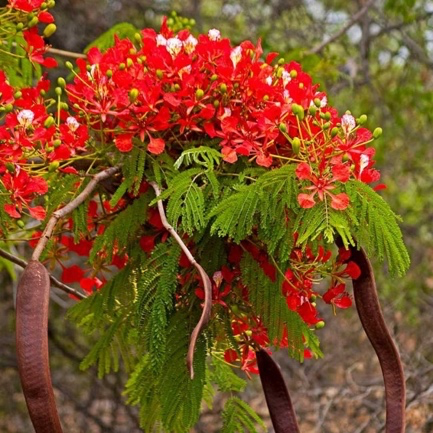
Note: Do not confuse with หางนกยูงไทย. The "Thai peacock's tail" is Caesalpinia pulcherrima, a small shrub with much smaller flowers. The ฝรั่ง ("foreign") in this tree's name is what marks it as the large imported tree.
How to Identify
- Habit: A medium-sized deciduous tree, 10–15 m tall, with a broad, flat-topped, umbrella-shaped crown that is often wider than the tree is tall.
- Bark: Light brown to greyish-white, smooth to slightly cracked, creased at the branch junctions and marked with prominent lenticels. The inner bark is light brown.
- Leaves: Bipinnate (twice-divided, fern-like), 30–40 cm long, with 8–25 or more pairs of pinnae, each pinna carrying 30–60 or more small opposite leaflets. Individual leaflets are oblong and tiny — 4–12 mm — dark green and dull above, paler greyish beneath. The whole tree typically drops its leaves at once, leaving bare branches before flowering.
- Flowers: Large and spectacular, in loose clusters. Four spreading scarlet to orange-red petals, plus a fifth upright "standard" petal that is larger and marked with white and yellow streaks — this odd fifth petal is a reliable identification point.
- Fruit: A large, flat, woody pod 30–50 cm long, about 5–7.6 cm wide and 3.8 cm thick. Green and flexible when young, ripening to dark brown, hard and woody, with horizontally divided seed chambers inside. The pods hang on the tree long after ripening and rattle in the wind.
Ecological Importance
- Major nectar source: The large, nectar-rich flowers draw bees (especially carpenter bees), butterflies, and nectar-feeding birds such as sunbirds, at the hottest, driest point of the year when few other trees are flowering.
- Shade and cooling: The wide umbrella crown of fine bipinnate foliage casts dense shade — one of the best shade trees available for a tropical campus courtyard or car park.
- Dry-season strategy: Full leaf drop before flowering reduces water loss and makes the flowering display visible from a distance.
Two practical cautions for campus planting
Aggressive roots. Thai sources warn explicitly that the roots travel far and can lift and crack roads, footpaths and other structures. Keep it well back from buildings, paving, and underground pipes.
Brittle branches. The wood is soft and limbs break in storms. Do not site it directly over parked cars or seating without a maintenance plan.
Being a legume does not automatically mean a tree fixes nitrogen. Delonix regia belongs to the Caesalpinioideae, the legume subfamily in which root nodulation is largely absent — so it should not be assumed to be enriching the soil the way an acacia or a leucaena would.
Uses and Importance
Food
- Not a food crop. No part is a staple vegetable, fruit, or grain, and the seeds and pods are not eaten in Thailand.
- The one real food application is from the flowers: their pigments and polysaccharides have been characterized and evaluated for use as a natural colorant and sweetener in beverages. The flowers are also a good nectar source for honey production.
Medicinal — By Part and Ailment
Traditional uses plus laboratory findings. None is an approved clinical treatment — do not self-medicate.
| Part | Traditionally Used For / Documented Activity |
|---|---|
| Leaves — generally the richest source of the plant's active compounds | Diabetes, inflammation, diarrhea, and wound healing; documented antidiabetic, anti-inflammatory, antidiarrheal, antioxidant, and cardioprotective activity |
| Flowers | A traditional herbal remedy for gynecological complaints, including dysmenorrhea (painful menstruation); documented antibacterial, anti-inflammatory, analgesic, antifungal and antioxidant activity. Also used as a tablet binder in pharmacy |
| Stem bark | Folk use for rheumatism and malaria; bark preparations show antioxidant, anticancer, hepatoprotective, cytotoxic, gastroprotective and antimicrobial properties, and produced the strongest anti-inflammatory and analgesic effect of the parts tested |
| Roots | Antibacterial activity, particularly against Staphylococcus and E. coli |
| Seeds | Antidiarrheal, anthelmintic (worms), larvicidal, antihemolytic and wound-healing activity |
Key research findings
- Folk medicine across cultures uses the tree for constipation, inflammation, arthritis and rheumatoid arthritis, hemiplegia, leucorrhea, diabetes, pneumonia, and malaria.
- Active compounds: flavonoids, alkaloids, saponins, sterols, β-sitosterol, lupeol, tannins, carotenoids and phenolic acids. The flavonoids and triterpenes account for much of the analgesic and antioxidant action.
Economic
- Ornamental and shade tree — by far its main value; one of the most widely planted flowering avenue trees in the tropics.
- Seed gum: the seeds yield a galactomannan, a polysaccharide with thickening and binding uses.
- Flower pigment and polysaccharide as a natural colourant and sweetener.
- Minor products: soft low-grade timber and fuelwood; the dry pods are used as rattles and percussion instruments in several cultures.
Cultural
- Thailand: D. regia is the royally bestowed tree of Thammasat University, where it is called ต้นยูงทอง. It is also the official tree of Uttaradit Rajabhat University, Thepsatri Rajabhat University, and the Air Technical Training School.
- The graduation tree: across Thailand, Vietnam, and much of tropical Asia it flowers precisely at the end of the school year, so its scarlet display is culturally bound up with farewells, final exams, and graduation.
- Naming: Delonix comes from the Greek delos ("evident") and onyx ("claw"), describing the long-clawed petals. "Poinciana" commemorates Philippe de Longvilliers de Poincy, a French noble who governed Saint Kitts. The tree was brought to scientific notice in 1824 by the botanist Wenzel Bojer in Madagascar.
Distribution & Habitat
- Origin: Native to Madagascar, in the dry deciduous forests of the west of the island.
- A conservation story: For much of the twentieth century, the tree was known almost entirely from cultivation and was feared to be nearly extinct in the wild — planted in every tropical city on Earth while its native population went unrecorded. Wild populations were subsequently located in western Madagascar, and it is now assessed as Least Concern (IUCN).
- Present range: Pantropical. Grown throughout the tropics and warm subtropics — including every region of Thailand.
- Habitat preferences: Full sun and free-draining soil. Strongly drought-tolerant once established, tolerant of poor soils and coastal salt, and adapted to a pronounced dry season. It does not tolerate frost or waterlogging.
Flowering & Fruiting
Flowering: The main flush comes in the hot dry season — roughly April to June in Thailand — typically after the tree has shed its leaves, so the flowers appear on bare branches. Scattered flowering can continue into the early rains.
Leaf behavior: The tree usually drops all its leaves together, then flowers, then flushes new fern-like foliage with the rains.
Pollination: By bees, butterflies, and nectar-feeding birds.
Fruiting: Pods develop through the wet season and take many months to mature, hardening into woody brown pods that persist on the tree into the following year — so a tree often carries last season's pods and this season's flowers at once.
Propagation: By seed. The hard seed coat needs scarification or hot-water soaking before sowing; without it, germination is poor and erratic.
Did You Know?
- It was planted all over the world before anyone could find it growing wild. Delonix regia comes from Madagascar, but for decades it was known almost only from gardens and was thought to be effectively extinct in its native habitat. Wild populations in western Madagascar were located later, and it is now rated Least Concern — a rare case of horticulture preserving a species while botany caught up.
- Its name means "obvious claw." Delos + onyx in Greek — a description of the long, narrow stalk at the base of each petal. And look closely at any flower: four petals match, and the fifth is different, larger and streaked with white and yellow. That odd petal is the nectar guide.
- In Thailand, it is the tree of graduation. Thammasat students call it ต้นยูงทอง, and across the region its flowering coincides so exactly with the end of the academic year that the scarlet canopy has become the visual symbol of leaving school. For a campus sign, that is the fact students will remember.
References
- Modi, A. et al. (2016). Delonix regia: historic perspectives and modern phytochemical and pharmacological researches. Chinese Journal of Natural Medicines.
- Shirsath, M. et al. (2022/2023). A review on introduction to Delonix regia and its various uses or activities. World Journal of Pharmaceutical Research / International Journal of Pharmaceutical Sciences.
- Utilizing the medicinal properties of Delonix regia for diseases and beyond: a review of its phytochemistry and pharmacology (2023). Tropical Journal of Natural Product Research, 7(12). doi:10.26538/tjnpr/v7i12.2
- Delonix regia leaf extract (DRLE): a potential therapeutic agent for cardioprotection. PMC5147973.
- Antioxidant and antimicrobial attributes and phenolics of different solvent extracts from leaves, flowers and bark of Gold Mohar [Delonix regia]. Molecules, 16: 7302. PMC6264588.
- Characterization of Delonix regia flowers' pigment and polysaccharides: antibacterial, anticancer and antioxidant activities, and application as a natural colorant and sweetener in beverages. PMC10096959.
- Tamaki, Y., Teruya, T. & Tako, M. (2010). The chemical structure of galactomannan isolated from seeds of Delonix regia. Bioscience, Biotechnology and Biochemistry, 74(5): 1110–1112.
- Rivers, M. (2014). Delonix regia. IUCN Red List of Threatened Species.
- PROTA / Useful Tropical Plants — Delonix regia. tropical.theferns.info/viewtropical.php?id=Delonix+regia
- Wikipedia — Delonix regia and Delonix (description, etymology, taxonomy).
- Thai Wikipedia — หางนกยูงฝรั่ง (Thammasat "ต้นยูงทอง", other university trees, root damage to pavements).
- Royal Park Rajapruek plant database — หางนกยูงฝรั่ง. rpplant.royalparkrajapruek.org/Display/details_fn/1571
- Khon Kaen University tree project (tree.kku.ac.th) — หางนกยูงฝรั่ง: dimensions and leaf structure.