
AIU Campus Plant Profile
Bottle Palm
Hyophorbe lagenicaulis (L.H. Bailey) H.E. Moore
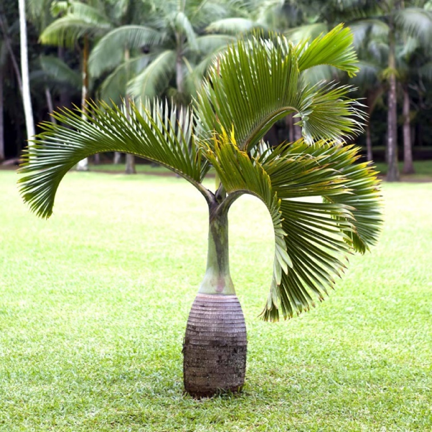
Note: Do not label this tree ปาล์มขวด. Although ปาล์มขวด translates literally as "bottle palm," in Thai horticultural usage it refers to a different species — the Royal Palm, Roystonea regia. Thai references are explicit that the palm English speakers call Bottle Palm is known in Thailand as แชมเปญปาล์ม / ปาล์มแชมเปญ. Thailand's national biodiversity database (THBIF) lists ปาล์มแชมเปญ as the accepted Thai name.
How to Identify
- Habit: A small, solitary (single-stemmed) palm, typically 3–6 m tall. It does not sucker or form clumps.
- Trunk — the defining feature: Smooth, grey, marked with close ring scars from fallen leaves, and swollen from near the base then tapering upward into a narrow neck — the shape of a bottle. The swollen section reaches up to 60 cm in diameter. The trunk becomes progressively slenderer as the palm ages.
- Crownshaft: A smooth green or maroon column of tightly wrapped leaf bases above the trunk, from beneath which the flowers emerge.
- Leaves: Pinnate (feather-like), up to 3.5 m long, arching outward and down, arranged in a spiral at the very top. Distinctively, the palm carries only four to six (up to eight) open leaves at any one time — a sparse crown. Young palms have leaves tinted red or orange, deepening to green at maturity.
- Flowers: Small and cream-white, borne on a large inflorescence that emerges from below the crownshaft. The inflorescence branches to four orders, which is a formal identification character for this species.
- Fruit: Small, about 2.5 cm, ripening from orange to black.
- Distinguishing it from the Spindle Palm (H. verschaffeltii): Both have swollen trunks. The Spindle Palm swells in the middle, like a spindle; the Bottle Palm swells near the base and tapers upward.
Ecological Importance
In Its Native Habitat (Round Island, Mauritius)
- Part of a highly specialised island endemic community that also includes the blue latan palm, the hurricane palm, and endemic reptiles found nowhere else.
- Endemic reptiles — notably the day gecko Phelsuma guentheri — are thought to have contributed to pollinating Mascarene palms, and the decline of these reptiles has likely disrupted that ecological role. This is a textbook example of pollinator loss on an isolated island.
- Adapted to salt spray, drought, and wind on an exposed volcanic islet.
- A conservation success story: following the eradication of introduced rabbits and goats and the control of rats, populations of H. lagenicaulis on Round Island increased significantly, and the species is now described as regenerating well.
In Cultivation (On Our Campus)
Its ecological contribution is modest and should be described honestly — the flowers offer nectar to bees and small insects, and birds take the small fruits. Its greater value here is educational and ex-situ conservation: every cultivated specimen is a living representative of a species that barely survives in the wild.
Uses and Importance
Food — None
No part of this palm is used as food. It is not a fruit, oil, sugar, or palm-heart crop. The fruits are small and not eaten. Given the species' critically endangered status, cutting a palm for its heart would be indefensible in any case. Its only food-web role is nectar for insects and fruit for birds.
Medicinal — None Documented
Unlike most plants in this profile series, H. lagenicaulis has no established traditional or pharmacological medicinal use. No plant part is recorded in traditional medicine, and there is no significant pharmacological literature on it. This is worth stating plainly on a sign — not every plant is a medicine, and the honest answer is more useful to students than an invented one.
Economic
This is where the species matters commercially. Despite being one of the rarest palms on Earth in the wild, it is one of the most recognizable and widely cultivated ornamental palms in tropical landscapes worldwide — a major nursery, landscaping, and container-plant crop from Florida to Singapore to Thailand. It is valued for its compact size, sculptural trunk, salt tolerance, and low maintenance, and it is widely grown in Mauritius itself.
Cultural
- It is an emblem of Mauritian conservation and of Round Island Nature Reserve, one of the most important seabird and reptile sanctuaries in the Indian Ocean.
- In Thailand, the "champagne palm" is a status ornamental — planted at hotel entrances, resorts, and institutional frontages precisely because its bottle-shaped trunk reads as distinctive and expensive.
- The species has a curious taxonomic history in botanical gardens: palms labelled as the near-extinct H. amaricaulis in eight botanical gardens across India, Cuba, the USA, Ghana, Canada, Ireland, Australia, and the UK were all found in 1990 to be misidentified H. lagenicaulis.
Distribution & Habitat
- Origin: Endemic to Round Island, Mauritius — a single 219-hectare volcanic islet lying about 22.5 km northeast of Mauritius in the Mascarene Archipelago of the Indian Ocean. This is one of the most geographically restricted palm species in the world.
- Wild status: Critically Endangered (IUCN). The entire native wild stock is reported as roughly 10 to 15 mature, seed-bearing individuals plus a small number of juveniles. It has been described as effectively extinct on mainland Mauritius, surviving in the wild only on Round Island — though it is now regenerating there following invasive-mammal removal.
- Cultivated range: Pantropical. Grown throughout the warm tropics and subtropics, including all of Thailand.
- Growing conditions: Full sun, warm frost-free climate, and well-drained soil. Highly tolerant of drought, wind, and salt spray; intolerant of cold and of waterlogged ground. Easy to grow, which is exactly why it spread through horticulture so successfully.
Flowering & Fruiting
Flowering: Inflorescences emerge from beneath the crownshaft, below the leaves, and branch to four orders. Flowering is not tied to a single narrow season in the tropics — mature palms can flower and fruit through much of the year in warm climates, with the flush usually following the warm wet period.
Maturity: Slow. Palms take several years to develop the swollen trunk and longer still to flower; a young plant looks like an ordinary small feather palm.
Fruiting: Fruits are about 2.5 cm, orange ripening to black, each containing one seed.
Propagation: By seed only. The palm is solitary and produces no suckers or offsets, so it cannot be divided — every plant in the nursery trade began as a seed.
Did You Know?
- One of the rarest palms in the world — and one of the most common in gardens. Its entire wild population is about 10 to 15 mature individuals on a single small islet, yet it is planted by the thousands in tropical landscapes across the globe. The horticultural trade has, in effect, preserved a species that nature almost lost — a genuinely striking illustration of ex-situ conservation.
- The swollen trunk is not a water tank. The widespread belief that the bottle shape stores water for the dry season is a myth. The swelling is a growth form, not a reservoir. Also counter-intuitive: the trunk becomes more slender, not fatter, as the palm ages.
- Removing rabbits saved it. Round Island's endemic plants collapsed under introduced rabbits and goats. After those animals were eradicated and rats controlled, bottle palm numbers on the island rose significantly. It is one of the clearest demonstrations available of what invasive-species removal can achieve.
References
- IUCN Red List — Hyophorbe lagenicaulis (Critically Endangered assessment).
- Asmussen-Lange, C.B., Maunder, M. & Fay, M.F. (2011). Conservation genetics of the critically endangered Round Island bottle palm, Hyophorbe lagenicaulis (Arecaceae): can cultivated stocks supplement a residual wild population? Botanical Journal of the Linnean Society, 167(3): 301–310.
- Dransfield, J. (1996). Hyophorbe lagenicaulis (Palmae). Curtis's Botanical Magazine, 13(4): 186–190.
- Maunder, M., Lyte, B., Dransfield, J. & Baker, W. (2001). The decline and conservation management of the threatened endemic palms of the Mascarene Islands.
- North, S.G., Bullock, D.J. & Dulloo, M.E. (1994). Changes in the vegetation and reptile populations of Round Island, Mauritius, following eradication of rabbits. Biological Conservation, 67: 21–28.
- Mauritian Wildlife Foundation — Round Island Nature Reserve description. mauritian-wildlife.org
- Friedman, M.H., Andreu, M.G., Quintana, H.V. & McKenzie, M. (2010). Hyophorbe lagenicaulis, Bottle Palm. FOR 245, University of Florida IFAS Extension.
- National Parks Board Singapore — Flora & Fauna Web: Hyophorbe lagenicaulis. nparks.gov.sg/florafaunaweb/flora/2/6/2631
- PACSOA (Palm & Cycad Societies of Australia) Wiki — Hyophorbe lagenicaulis.
- Thailand Biodiversity Information Facility (THBIF), ONEP — ปาล์มแชมเปญ. thbif.onep.go.th/taxons/detail/58542
- Wikipedia — Hyophorbe lagenicaulis, Hyophorbe verschaffeltii, Hyophorbe amaricaulis.