
AIU Campus Plant Profile
Copperpod
Peltophorum pterocarpum (DC.) Backer ex K. Heyne
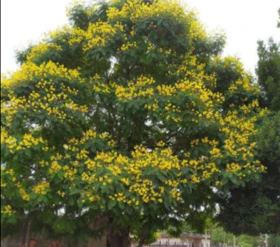
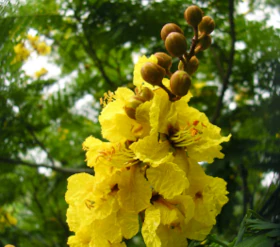
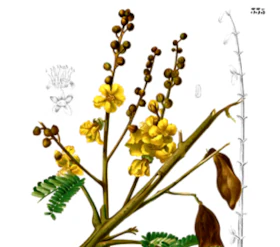
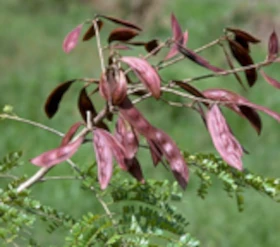
A Thai pair worth distinguishing. นนทรีบ้าน is this species, P. pterocarpum. นนทรีป่า (also called อะราง) is Peltophorum dasyrachis, a different forest species in the same subfamily. As with ประดู่บ้าน / ประดู่ป่า, the บ้าน / ป่า pairing marks the planted tree against the wild one.
How to Identify
- Habit: A deciduous to semi-deciduous tree, commonly 8–20 m and reaching 25 m (exceptionally 50 m), with a trunk up to 1 m in diameter and a straight, sometimes buttressed bole. The crown is dense, spreading and umbrella shaped.
- Bark: Smooth and grey — noticeably smoother than most of the other large legumes on campus.
- Leaves: Bipinnate (twice-divided) and very large, 30–60 cm long, with 8–20 pairs of pinnae, each carrying 20–40 small oblong leaflets only 8–25 mm long and 4–10 mm wide, with oblique (lopsided) bases. The overall effect is fine and fern-like.
- Flowers: Bright golden-yellow, each about 2.5–4 cm across, with crinkled petals, borne in large erect terminal panicles up to 20 cm long. The flowers are fragrant, especially at night. The identifying detail: the flower stalks and unopened buds are covered in dense rust-brown (ferruginous) hairs, so a spike of yellow flowers sits on a visibly rusty-brown stem — hence “rusty shield bearer.”
- Fruit: A flat, thin, winged pod 5–10 cm long, holding 1–4 seeds. It is bright red when young, ripening through copper to black — the source of the name “copperpod.” Old blackened pods hang on the tree for months.
- Root system: Deep.
Ecological Importance
- Nitrogen fixation: P. pterocarpum is recorded as able to fix nitrogen and is used as a green manure and soil improver — a useful contrast with Delonix regia, its close relative in the same subfamily, which does not nodulate.
- Night-scented flowers: fragrance peaking at night points to moth visitors alongside the daytime bees; the tree is a heavy pollen and nectar producer during the dry season.
- Coastal and mangrove-margin species: in the wild it is a lowland tree, rarely found above 100 m, growing along beaches and on the inner margins of mangrove forest. That origin explains its tolerance of salt, wind and poor sandy soil.
- Deep roots make it wind-firm, and drought-hardy once established — and less likely than shallow-rooted campus trees to lift paving.
- Shade and hedging: the dense umbrella crown makes it a first-rate shade tree, and it can be maintained as a hedge.
Campus note: the pods and spent flowers fall in quantity, so it produces a lot of litter over paths and parked cars in the flowering season. Good for the compost heap, less good directly above a walkway.
Uses and Importance
Food
- Not a food plant — there is no known edible part.
- Its only food-system role is indirect: the abundant flowers are worked by bees, and in Indonesia the bark is used in fermenting palm wine.
Medicinal — By Part and Ailment
Traditional and experimental uses. Not approved clinical treatment — do not self-medicate.
| Part | Traditionally Used For / Documented Activity |
|---|---|
| Bark — the main part used | Dysentery and diarrhoea; as an eye lotion; as an embrocation (rub) for muscular pain, sores, sprains, bruises and swelling; and as an astringent for intestinal disorders and pain after childbirth. Also used for gargles and tooth powders. The bark is rich in tannins (11–21%, of the proanthocyanidin type) |
| Leaves | A decoction is used by traditional healers for skin diseases and ringworm; the leaflets and buds contain an antifungal principle. Leaf extract also showed strong inhibition of skin-ageing enzymes in cosmetic screening |
| Flowers | Used as a lotion for muscle aches, eye problems and sores, and as an astringent for intestinal complaints, bruises, sprains and swelling. The flower extract is regarded as a sleep inducer used for insomnia, and an alcoholic extract shows anti-inflammatory and antibacterial activity. The flowers contain the pigment naringenin 7-glucoside |
| Stem infusion | Dysentery, gargles, tooth powder and muscular pain |
| Whole plant (traditional Chinese and Vietnamese medicine) | Stomatitis, insomnia, skin troubles, constipation and ringworm — P. pterocarpum is regarded as one of the important medicinal plants of Vietnamese traditional medicine |
Key research findings
- Ethanolic extracts of the leaves and stem bark inhibited LDL oxidation in a dose-dependent way and showed cytotoxic activity against cancer cell lines.
- Leaf and bark preparations showed hepatoprotective activity in rats given isoniazid and rifampicin.
Economic
- Dye — the historically important use. The bark yields a yellowish-brown dye used for cotton, batik and preserving and dyeing fishing nets. It is the key ingredient of the dark brown-black “soga” dye of inland Java, where it is blended with the bark of Ceriops tagal and the wood of Maclura cochinchinensis. The characteristic brown of Javanese batik comes from this tree — which is why Indonesians call it soga.
- Tanning: the tannin-rich bark is used for leather.
- Timber: used for construction, boat building, cabinet making and fuelwood.
- Ornamental: one of the most widely planted yellow-flowering avenue trees in the tropics; the flowers can even be used as cut flowers.
- Green manure and soil improvement.
Cultural
- นนทรี is the symbolic tree of Kasetsart University, adopted in 1963 after the Kasetsart alumni association meeting of 9 April that year — the dark green leaves standing for the green of agriculture and the golden flowers for the faculty colour.
- It is also the provincial tree of Nonthaburi, whose name it echoes.
- In Bengal the tree is known as radhachura, and in Vietnam as lim xẹt.
Distribution & Habitat
- Origin: Native to tropical Southeast Asia and northern Australasia — from eastern and southern India and Sri Lanka through Thailand, Vietnam, Malaysia, Indonesia, the Philippines and Papua New Guinea to northern Australia. Thailand is within its natural range.
- Natural habitat: A lowland species, rarely occurring above 100 m altitude, characteristically along beaches and the inner margins of mangrove forest.
- Present range: Planted as an ornamental and avenue tree throughout the tropics.
- Growing conditions: Full sun, tolerant of sandy and saline soils and of coastal wind, drought-hardy once its deep roots are established, and fast-growing. Not frost-hardy.
Flowering & Fruiting
Flowering: The main display comes in the dry season, roughly March to June in Thailand, when the whole crown turns gold. The flowers are lightly fragrant, and more strongly so at night.
First flowering: Trees begin to flower at about four years old — fast by tree standards, and one reason it is popular for quick avenue planting.
Fruiting: Pods follow the flowers, red at first, then copper, then black, and persist on the tree well after ripening. Each holds one to four flat seeds, and the flat papery wing gives the species its epithet — pterocarpum means “winged fruit.”
Propagation: By seed; germination improves after scarification or hot-water treatment of the hard seed coat.
Did You Know?
- The brown in Javanese batik comes from this tree. The bark is the principal source of soga, the dark brown-black dye of inland Java, and Indonesians name the tree after the dye rather than the other way round. A single ornamental street tree in Thailand is the same species that colours a UNESCO-listed textile tradition.
- Its name describes a rusty shield. The flower buds and stalks are coated in rust-brown hairs, so each yellow flower spike sits on a visibly ferruginous stem — the origin of “rusty shield bearer.” And pterocarpum means “winged fruit,” for the flat papery pod that turns red, then copper, then black.
- It is a beach and mangrove tree in disguise. In the wild P. pterocarpum is a coastal species that rarely grows above 100 m, favouring beach edges and the inner fringe of mangroves. Everything that makes it a good campus tree — salt tolerance, wind resistance, deep roots, indifference to poor sandy soil — is an adaptation to the shoreline.
References
- World Agroforestry Centre (ICRAF) AgroforesTree Database — Peltophorum pterocarpum: description, habitat, soga dye, medicinal uses, nitrogen fixation. apps.worldagroforestry.org/treedb2/speciesprofile.php?Spid=18043
- Plants For A Future (PFAF) — Peltophorum pterocarpum: medicinal summary, antifungal principle, naringenin 7-glucoside, dye and timber uses. pfaf.org/user/Plant.aspx?LatinName=Peltophorum+pterocarpum
- Useful Tropical Plants — Peltophorum pterocarpum: bark tannin content, soga dye composition. tropical.theferns.info/viewtropical.php?id=Peltophorum+pterocarpum
- Peltophorum pterocarpum: chemical and pharmacological aspects. International Journal of Pharmaceutical Sciences and Research. ijpsr.com/bft-article/peltophorum-pterocarpum-chemical-and-pharmacological-aspects/
- Antioxidant and cell proliferation properties of the Vietnamese traditional medicinal plant Peltophorum pterocarpum. PMC7587549.
- A thorough examination of Peltophorum pterocarpum phytochemicals in network pharmacology-based management of acne vulgaris. PMC11439474.
- Hepatoprotective activity of Peltophorum pterocarpum leaf and bark in isoniazid- and rifampicin-induced hepatotoxic rats.
- de Kok, R. (2024). Peltophorum pterocarpum. IUCN Red List of Threatened Species. doi:10.2305/IUCN.UK.2024-1.RLTS.T176418249A203233433.en
- Wikipedia — Peltophorum pterocarpum (description, leaf and pod dimensions, soga/batik, native range).
- Thai Wikipedia — นนทรี (Thai regional names, flowering season, provincial tree of Nonthaburi).
- Kasetsart University, Kamphaeng Saen Campus — ต้นนนทรี: ต้นไม้สัญลักษณ์ของมหาวิทยาลัยเกษตรศาสตร์ (adoption in 1963). kps.ku.ac.th
- Department of Science Service OTOP plant-dye database — นนทรี: Thai names, subfamily, relation to อะราง (นนทรีป่า). otop.dss.go.th