
AIU Campus Plant Profile
Royal Palm
Roystonea regia (Kunth) O.F. Cook
The naming pair to teach alongside this one. In Thai, ปาล์มขวด is Roystonea regia — but in English, "Bottle Palm" means a completely different species, Hyophorbe lagenicaulis, which Thai calls ปาล์มแชมเปญ. The two names cross over exactly. Thai horticultural writers warn about this confusion explicitly.
Synonyms on older labels: Oreodoxa regia, Roystonea elata, Roystonea ventricosa, Roystonea floridana.
How to Identify
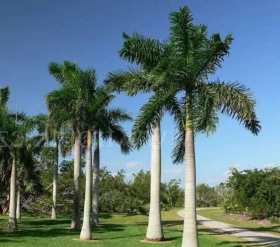
- Habit: A tall, solitary, single-stemmed palm reaching 15–24 m, and up to about 25 m in Thai plantings.
- Trunk — the key feature: A smooth, columnar, whitish-grey to grey-brown stem resembling a poured concrete pillar, with faint ring scars. Thai references describe the profile precisely: narrowed near the base, bulging through the middle, and tapering toward the top. Diameter is about 50 cm. In young palms the base is the thickest part; as the palm matures the swelling shifts upward to the middle.
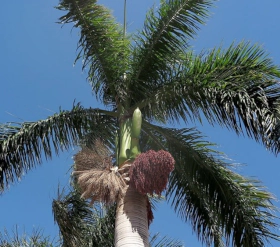
- Crownshaft: A striking, glossy deep green column up to 1 m long, formed by the tightly wrapped leaf bases directly above the trunk.
- Leaves: Pinnate (feather-like), 5–6 m long, arching. The identifying detail: the leaflets emerge from the midrib at several different angles rather than in a single flat plane, so the frond looks full and plume-like, almost like a giant bottle-brush. Bright fresh green.
- Flowers: Borne on a large, much-branched inflorescence that emerges from below the crownshaft. Individual flowers are small and white to cream; male and female flowers occur on the same inflorescence.
- Fruit: Small, roughly 1–1.5 cm, ellipsoid, ripening green → red → purple-black, carried in large hanging bunches.
Ecological Importance
- Feeds birds and bats: The fruit is eaten by birds and bats, which disperse the seeds, and the flowers are visited by birds and bats as well as bees.
- Habitat structure: The palm serves as a roosting site and food source for a variety of animals — the crown, old leaf bases, and cavities in dead trunks all provide shelter.
- Wind resilience: The flexible trunk and self-shedding fronds let it survive tropical storms that break other trees, which is why it dominates avenue planting across the hurricane belt.
- In the Cuban landscape: It is the defining tree of Cuba's agricultural countryside, standing in pastures and field margins where it functions as scattered habitat in an otherwise cleared landscape.
Campus safety note: Royal palm fronds are very large and heavy, and the palm sheds them cleanly when they die. Do not plant it directly over benches, walkways, or parking, and inspect for hanging dead fronds before events beneath it.
Uses and Importance
Food
| Part | Use |
|---|---|
| Fruit ("palmiche") | The most important food use — fed to livestock, above all to pigs in Cuba, where it is a traditional staple feed. Not a human food |
| Palm heart (apical bud) | Edible, but harvesting it kills the palm, so it is not a sustainable use of a mature landscape tree |
| Seed | Yields an oil |
Medicinal — by part and ailment
This palm is unusual: it is one of very few palms that has yielded a genuinely approved medicine, alongside saw palmetto.
| Part | Used for |
|---|---|
| Fruit — the important one | The lipid extract of the fruit, developed in Cuba under the research code D-004 and marketed as Palmex, is used for benign prostatic hyperplasia (BPH) — non-cancerous prostate enlargement causing difficulty urinating |
| Root | Used in traditional medicine in eastern Cuba to treat impotence |
| Leaf | Not medicinal — used for thatch (see Economic) |
How the fruit extract works
- D-004 is a mixture of free fatty acids, mainly oleic, lauric, palmitic, and myristic acids.
- It inhibits prostate 5α-reductase, the enzyme that converts testosterone into dihydrotestosterone, which is what drives prostate cell growth. Consistent with this, it prevents testosterone-induced prostate hyperplasia in rodents but not dihydrotestosterone-induced hyperplasia.
- It also antagonises α1-adrenoceptor–mediated responses, addressing the muscular component of the disease, and shows antioxidant activity in prostate tissue.
- In comparative studies its efficacy is similar to saw palmetto, and it has been trialled against finasteride and tamsulosin.
- Safety: experimental toxicology found oral administration safe in rodents and dogs over short and long terms, with no genotoxicity, reproductive toxicity, or long-term carcinogenicity.
Economic
- Ornamental — this is the archetypal grand avenue palm, planted throughout the tropics and subtropics, and one of the most commercially important landscape palms in the world.
- Thatch from the leaves and construction timber from the trunk.
- Livestock feed and seed oil from the fruit.
- Pharmaceutical — the fruit lipid extract is produced commercially in Cuba.
Cultural
- Roystonea regia is the national tree of Cuba and appears on the national coat of arms — the single most recognisable plant symbol of the country.
- In Thailand ปาล์มขวด is a formal, institutional palm: planted in avenues at universities, government buildings, hospitals, and hotel approaches, where a double row signals a main entrance.
- The genus honours General Roy Stone, a US Army engineer who worked in Puerto Rico.
Distribution & Habitat
Origin: Native to Mexico, the Caribbean (including Cuba and the Bahamas), southern Florida, and parts of Central America. The Cuban and Florida populations were long treated as separate species but are now recognised as one.
Present range: Planted throughout the tropics and subtropics as an ornamental — including all regions of Thailand.
Habitat: Humid lowlands, riverbanks, and the margins of swamps and seasonally wet ground. It prefers full sun, deep soil, and reliable moisture, and unlike many landscape palms it is not a dry-country species — it grows fastest with steady water. Moderately salt- and wind-tolerant; not frost-hardy.
Conservation status: Least Concern (IUCN) — abundant in the wild and enormously widespread in cultivation.
Flowering & Fruiting
Flowering: Inflorescences emerge from beneath the crownshaft, below the leaf bases, opening as large branched sprays of small cream-white flowers. In a warm climate like Saraburi's, a mature palm flowers and fruits through much of the year rather than in a single narrow season.
Pollination: By insects, chiefly bees; the flowers are also visited by birds and bats.
Fruiting: Heavy hanging bunches of small fruits ripen from green through red to purple-black. Each fruit contains one seed.
Propagation: Seed only. The palm is solitary and produces no offsets, so it cannot be divided. Seedlings are slow at first, then grow rapidly once the trunk forms.
Did You Know?
- It is the national tree of Cuba, and it is on the coat of arms. No other plant is as tied to a national identity in the Caribbean — the royal palm standing alone in a pasture is the visual shorthand for the Cuban countryside.
- Its fruit produced a real prescription medicine. Most "medicinal plant" claims stop at traditional use. This one did not: Cuban researchers turned the fruit into D-004 / Palmex, a treatment for benign prostatic hyperplasia that inhibits prostate 5α-reductase — the same enzyme targeted by the pharmaceutical finasteride. It is one of only two palms worldwide to have yielded an approved drug.
- Thai and English swap the name "bottle palm." ปาล์มขวด is this palm, Roystonea regia. The palm English speakers call Bottle Palm is Hyophorbe lagenicaulis, which Thai calls ปาล์มแชมเปญ. If your campus has both, the two signs together make an excellent lesson in why scientific names exist.
References
- Wikipedia — Roystonea regia (distribution, description, ecology, uses, status).
- Gruca, M., van Andel, T.R. & Balslev, H. (2014); Zona, S. & Henderson, A. — reviews of medicinal palm species, including Roystonea regia root use in eastern Cuba.
- Arruzazabala, M.L., Carbajal, D., Mas, R. et al. (2004). Preventive effects of D-004, a lipid extract from Cuban royal palm (Roystonea regia) fruits, on prostate hyperplasia induced with testosterone in intact and castrated rodents. Drugs under Experimental and Clinical Research, 30: 227–234.
- Carbajal, D. et al. (2006). Effect of D-004, a lipid extract from Cuban royal palm fruit, on histological changes of prostate hyperplasia induced with testosterone in rats. PMID: 16440586.
- Pérez, Y., Menéndez, R., Mas, R. & González, R. In vitro effect of D-004 on prostate steroid 5α-reductase activity. Current Therapeutic Research.
- Comparative study of the efficacy and tolerability of Palmex® (Roystonea regia lipid extract), saw palmetto, finasteride and tamsulosin in patients with benign prostatic hyperplasia. PMC11923598.
- Royal Park Rajapruek plant database — ปาล์มขวด Roystonea regia. https://rpplant.royalparkrajapruek.org/Display/details_fn/5257
- Khon Kaen University Museum plant record — ปาล์มขวด. https://museum.kku.ac.th
- Thai Kasetsart — การปลูกปาล์มชนิดต่าง ๆ (trunk shape, and the ปาล์มขวด / แชมเปญปาล์ม naming distinction).