
AIU Campus Plant Profile
Rain Tree
Samanea saman (Jacq.) Merr.
How to Identify
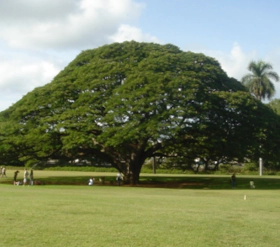
- Habit: A very large, fast-growing, semi-deciduous tree. In urban planting it reaches 20–30 m, and over 40 m in its native habitat. The crown is the identifying feature: an enormous, symmetrical, dome- or parasol-shaped canopy that can exceed 50 m across — usually much wider than the tree is tall. The trunk is short and often crooked relative to that crown, 1–2 m in diameter, and the root system is shallow and spreading.
- Bark: Greyish-brown, rough and cracked, peeling off in flakes on mature trees.
- Leaves: Bipinnate (twice-divided) and spirally arranged, with 4–20 leaflets per pinna in opposite pairs. Leaflets are ovate, elliptic, or diamond-shaped, asymmetric, and get larger toward the tip of the pinna.
Field test: watch the leaves at dusk or on a heavily overcast afternoon. The leaflets fold shut — a movement called nyctinasty. This is the behaviour behind the name "rain tree."
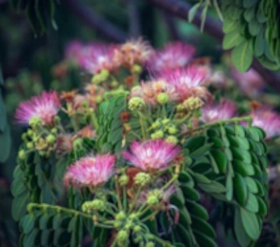
- Flowers: Dense, rounded head-like clusters borne in the leaf axils near the branch tips. The petals are small and fused into a tube; the show comes from the long protruding stamens, white at the base and pink above, giving each head the look of a powder puff.
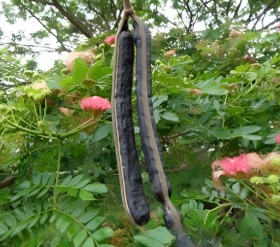
- Fruit: A straight, flattened, indehiscent pod 15–20 cm long, green ripening to blackish-brown, filled with sticky sweet blackish pulp around 15–25 seeds. The pods do not split open; they fall whole.
Ecological Importance
- It genuinely fixes nitrogen. Unlike Delonix regia, Samanea saman is a nodulating, nitrogen-fixing legume, and it is used in agroforestry for exactly that reason.
- Grass grows better beneath it. This is the tree's most remarkable ecological trait: because it enriches the soil with nitrogen and its leaflets fold to let light and rain through, pasture under a rain tree is often thicker than pasture in the open. Very few large shade trees improve what grows below them.
- Plantation shade tree: its dense canopy makes it a standard overstorey for coffee and cacao.
- Bee forage: the flowers are pollinated by bees and support honey production.
- Lac host: in northern Thailand the tree is grown specifically to raise ครั่ง (lac insects), a traditional resin industry.
- Urban cooling: research recommends S. saman for urban planting because it lowers outdoor temperature over every type of ground cover tested.
- Fodder and wildlife food: the sweet pods are eaten readily by cattle and by wildlife.
Cautions for campus planting
- It needs enormous space. A mature crown can spread 30–50 m. Thai horticultural sources warn against using it in small areas.
- Shallow roots lift paving and can suppress other planting beneath the canopy.
- Brittle limbs on a very heavy crown — large old specimens need inspection, especially near walkways and parking.
- Plant health: a 30-year-old rain tree in Thailand was documented as a host for the root-knot nematode Meloidogyne enterolobii — worth knowing if the tree stands near a nursery or vegetable plot.
Uses and Importance
Food
| Part | Use |
|---|---|
| Pod pulp | The sweet, sticky pulp is eaten, and can be made into a drink. Its main use is as cattle fodder — Thai sources note that cattle and buffalo readily eat the ripe pods |
| Young leaves | Eaten in salads in some regions, but only as a famine food, not a normal vegetable |
| Seeds | ⚠️ Raw seeds are toxic. Do not eat them |
| Flowers | Not eaten, but a valuable nectar source for honey |
Medicinal — by part and ailment
Traditional and experimental uses. Not approved clinical treatment — do not self-medicate.
| Part | Traditionally used for / documented activity |
|---|---|
| Bark | Diarrhoea and stomach pain; astringent. Also a source of gums and resins. Contains the alkaloid pithecolobine |
| Leaves | Used as a laxative; pithecolobine isolated from leaf extracts has been screened for antitubercular activity |
| Seeds | Traditionally chewed for sore throat |
| Whole plant / various parts | Anti-inflammatory, astringent, antifungal, antipyretic, antimalarial, laxative, and used for digestive and skin conditions |
Active compounds: the alkaloids pithecolobine (a spermine alkaloid) and a second alkaloid, plus the saponin samarin.
Documented pharmacological activity: antioxidant, antimicrobial, antidiabetic, antiulcer, anti-anxiety, analgesic, insecticidal, cytotoxic, allelopathic, and hepatoprotective.
Economic
- Timber ("monkeypod"): light in weight but highly durable, with beautiful figure — used for carving, furniture, panelling, bowls, boat building, interior trim, veneer, and general construction. In Thailand, ฉำฉา is the standard wood of northern woodcarving.
- Lac (ครั่ง) production in the north.
- Fodder from the pods, and shade in coffee and cacao plantations.
- Energy: the pods can be ground and converted to alcohol, and the species is being studied for biogas production from readily available urban and rural material.
- Compost and growing medium: the leaves are widely used in Thailand for compost and potting mixes.
Cultural
- จามจุรี is the symbolic tree of Chulalongkorn University, where royally bestowed specimens were planted — the single strongest cultural association this tree has in Thailand.
- It is not a Thai native. It was first brought to Thailand from Burma around 1900 (พ.ศ. 2443), and has become so familiar along roadsides and in village squares that most people assume it has always been here.
- The genus name comes from the Spanish saman, from zamang, the local name for the giant specimen Alexander von Humboldt saw near Maracay, Venezuela in 1799.
- In Cambodia the tree is known colloquially as the Chankiri tree (ចន្ទគិរី).
Distribution & Habitat
Origin: Native to tropical America — from Mexico south through Central America, Colombia, Venezuela and Ecuador to Peru and Brazil.
Introduced range: Widely planted across South and Southeast Asia and the Pacific, including Hawaii. In Thailand it arrived from Burma around 1900 and is now planted nationwide along roads, in villages, and on institutional grounds.
Habitat preferences: Thrives in the wet tropics with moderate to heavy rainfall, and is a water-loving tree. Unlike most of the trees in this series, it tolerates waterlogged and periodically flooded ground. It is not fussy about soil type and grows from sea level up to about 300–400 m, which is why it succeeds everywhere in Thailand.
Flowering & Fruiting
Flowering: Flowers through the year in Thailand, with the heaviest flush from about September to February.
Pollination: By bees.
Fruiting: Pods take several months to fill and darken, ripening to blackish-brown and falling whole. They do not split, so the pulp and seeds stay together until an animal breaks them open — the tree's dispersal strategy.
Growth rate: Very fast. Thai observers note the tree puts on visible size after each rainy season, which is one of the traditional explanations for the English name.
Did You Know?
- There are three competing explanations for the name "rain tree," and all of them are interesting. The best supported: the leaflets fold shut at night and under heavy cloud, so rain falls straight through the canopy to the ground below. The second: sap-sucking insects living in the crown drip honeydew, so the ground under the tree is damp even in dry weather. The third, offered by Thai writers: the tree grows so fast that it is visibly bigger after every rainy season.
- It is one of the very few big trees that improves the ground beneath it. Most large shade trees suppress what grows under them. The rain tree fixes nitrogen into the soil and folds its leaflets to let light and rain through, so pasture under the canopy is frequently better than pasture in the open.
- The most Thai-feeling tree on campus is an immigrant. จามจุรี arrived from Burma only around 1900. In a little over a century it has become the emblem of Chulalongkorn University and a fixture of the Thai roadside — a useful reminder that "traditional" landscapes are often recent.
References
- Vinodhini, S. & Devi Rajeswari, V. (2018). Review on ethnomedical uses, pharmacological activity and phytochemical constituents of Samanea saman (Jacq.) Merr., rain tree. Pharmacognosy Journal, 10(2).
- Staples, G.W. & Elevitch, C.R. (2006). Samanea saman (rain tree). Species Profiles for Pacific Island Agroforestry.
- Shanmuga-Kumar, S.D. & Satheesh-Kumar, G. (2014). Isolation of pithecolobine from the leaf extracts of Samanea saman (Jacq.) Merr. and its in vitro antitubercular screening. International Journal of Innovative Pharmaceutical Sciences and Research, 2: 1098–1106.
- Thippeswamy, S., Praveen, P. & Manjunath, K. (2011). Antimicrobial evaluation and phytochemical analysis of Samanea saman (Jacq.) Merr. against human and plant pathogenic bacteria and fungi. International Journal of Pharmaceutical and Biological Sciences, 2: 443–452.
- Ajam, S.M. et al. (2012). Cytotoxic activity of spermine alkaloids from Samanea saman.
- Plants For A Future (PFAF) — Samanea saman: uses, medicinal notes, nitrogen fixation, pollination. https://pfaf.org/user/Plant.aspx?LatinName=Samanea+saman
- Molecular phylogeny and morphological studies reveal a 30-year-old rain tree (Samanea saman) maintains populations of Meloidogyne enterolobii, a new host plant in Thailand.
- Wikipedia — Samanea saman and Samanea (taxonomy, range, Humboldt, Cambodian name).
- Queen Sirikit Botanic Garden (องค์การสวนพฤกษศาสตร์) BGO Plant Database — จามจุรี. http://www.qsbg.org
- NECTEC Plant Taxonomy encyclopedia — จามจุรี: Thai regional names, lac cultivation, carving wood, introduction date.
- Baan Lae Suan (บ้านและสวน) — ต้นจามจุรี หรือ ก้ามปู: crown spread, flowering season, flood tolerance, compost use. https://www.baanlaesuan.com/362848/plant-scoop/rain-tree/
- Silpa-Mag — จามจุรี ไม้สัญลักษณ์จุฬาลงกรณ์มหาวิทยาลัย ไม่ใช่ไม้ท้องถิ่นของไทย.