
AIU Campus Plant Profile
Big-leaf Mahogany
Swietenia macrophylla King
⚠ This is a CITES-listed, IUCN Endangered species.
Both facts belong on the sign. See Ecological Importance and Economic below — for a conservation-focused campus, this tree's story is the most valuable thing about it.
How to Identify
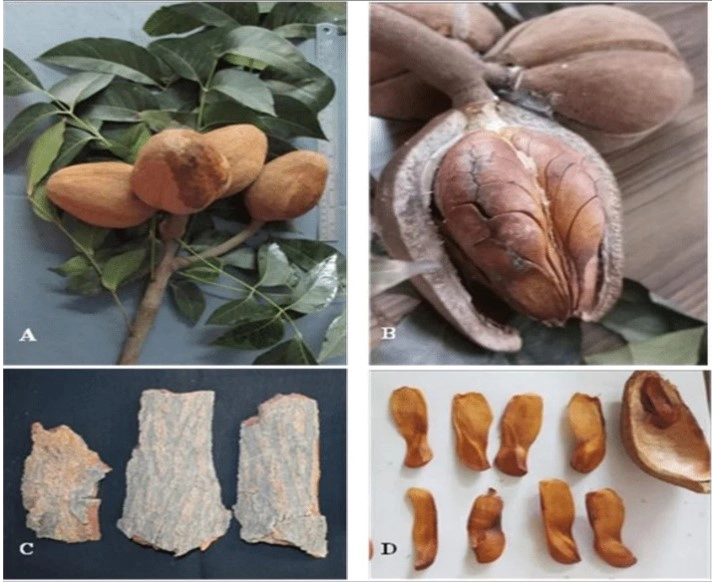
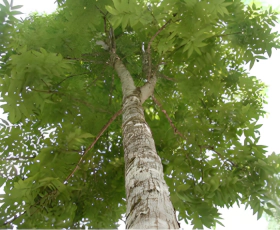
- Habit: A very large tree, reaching 30–45 m with a trunk up to 2 m in diameter. In forest it is an emergent, standing above the general canopy. Mature trees develop prominent plank buttresses at the base.
- Bark: Grey-brown, becoming deeply fissured and flaking in vertical strips with age. The inner bark is reddish.
- Leaves: Alternate and paripinnate — evenly pinnate, with no terminal leaflet. This is one of the quickest confirmations in the field: count the leaflets and you will find them in pairs, the leaf ending in two leaflets rather than one. The whole leaf is 20–45 cm long with 6–16 leaflets in 3–8 pairs.
- Leaflets: Lanceolate to ovate-lanceolate, 5–15 cm long, glossy dark green above, with a distinctly asymmetric (lopsided) base and a drawn-out pointed tip.
- Flowers: Small, about 8 mm, greenish-yellow to cream, fragrant, borne in loose branched panicles in the leaf axils. Individually unremarkable.
- Fruit — the giveaway, and the source of a name: A large woody capsule, 12–20 cm long, pear- or egg-shaped and grey-brown, held erect and pointing upward on the branch. This upward posture is why the tree is called sky fruit.
- How the capsule opens: It splits from the base upward into five woody valves, which fall away and leave a central woody column standing on the branch like a candlestick. The empty columns persist for months and are often the easiest sign to spot.
- Seeds: 40–70 per capsule, each 7–12 cm long including a long papery wing. They spin as they fall and are carried on the wind.
- Deciduous briefly in the dry season, dropping its leaves shortly before flowering.
Telling it apart from relatives on campus
| Species | Leaves | Fruit |
|---|---|---|
| มะฮอกกานีใบใหญ่ — S. macrophylla | Leaflets 5–15 cm, in 3–8 pairs | Capsule 12–20 cm |
| มะฮอกกานีใบเล็ก — S. mahagoni | Leaflets much smaller, 3–7 cm | Capsule 5–10 cm |
| สะเดา — neem, Azadirachta indica | Leaflets toothed along the margin; leaf ends in a terminal leaflet | Small yellow fleshy drupe |
Ecological Importance
- An emergent of neotropical forest. In its native range it towers above the canopy of lowland moist and seasonally dry forest, which is precisely what makes it visible — and vulnerable — to loggers.
- Naturally rare, by design. Mahogany typically occurs at very low density, often fewer than one mature tree per hectare. Selective logging therefore removes a large fraction of the reproductive population from a huge area, which is why "we only take a few trees" is so misleading for this species.
- Light-demanding and disturbance-dependent. Seedlings will not establish under closed canopy. The species regenerates in gaps created by treefalls, fire, floods and hurricanes — an ecology that depends on the forest being intact enough to produce gaps within it.
- Wind dispersal. The winged seeds are released in the dry season when the tree is leafless, so nothing obstructs their flight. The timing is not accidental.
- Pollination is by small insects — thrips, small bees and moths visiting the modest greenish flowers.
- One insect explains the whole plantation map. The mahogany shoot borer (Hypsipyla grandella in the Americas, H. robusta in Asia) bores into the terminal shoot, killing the leader and causing the tree to fork. Repeated attack ruins the straight bole that makes mahogany valuable. This pest is the main reason large mahogany plantations have largely failed in the Neotropics — and why plantations in Asia and the Pacific, originally beyond the reach of H. grandella, succeeded instead.
⚠ Conservation status — put this on the sign.
IUCN Red List: Endangered (2022 assessment, raised from Vulnerable). CITES Appendix II since 15 November 2003. Illegal logging continues despite both protections: a CITES Non-Detriment Findings report noted that in 2005, about 12% of exported mahogany volume came from illegal logging, and 83% of the companies exporting mahogany from Peru handled timber of illegal origin.
⚠ A second caution, in the other direction. Outside its native range mahogany has naturalised and become invasive in parts of Asia and the Pacific, including Sri Lanka, the Philippines, Indonesia, Fiji and Hawaii. The wind-borne seed travels well. It is not recorded as naturalised in Thailand, but this is another tree worth watching for volunteer seedlings beyond the planting.
Uses and Importance
Food
This is not a food plant. The seeds are intensely bitter and are not eaten as food. The name "sky fruit" refers to the shape and posture of the capsule and to the supplement trade, not to any culinary use. Nothing on this tree belongs in a meal.
Medicinal — by Part and Ailment
Traditional uses across South and Southeast Asia, plus what laboratory research has and has not established. These are ethnobotanical and preclinical records, not proven treatments.
| Plant Part | Recorded uses and findings |
|---|---|
| Seed | The principal medicinal part. Used traditionally across Malaysia, Indonesia and India to control blood sugar in diabetes and to lower high blood pressure — the raw seeds are traditionally chewed. In East Midnapore and West Bengal, India, healers use the seeds for diarrhoea. In Chinese and other traditional practice, dried powdered seed is used as an antipyretic, antifungal and antihypertensive. |
| Seed — chemistry | Contains limonoids (tetranortriterpenoids): swietenine, swietenolide, 3,6-O,O-diacetylswietenolide and augustineolide. Swietenine is regarded as the key active compound; in animal studies it showed hypoglycaemic and hypolipidemic effects, apparently by promoting glucose utilisation and PPARγ activation. Seed extracts have also shown anti-inflammatory, antioxidant, antimicrobial, antimutagenic and antitumour activity in preclinical assays, and aqueous extract has shown activity against Plasmodium falciparum. |
| Bark | Used as an astringent, including on wounds. Contains phenylpropanoid-substituted epicatechins, among them swietemacrophyllanin. |
| Leaves / whole plant | Recorded across the Asia-Pacific region for pain, leishmaniasis and malaria, and to promote blood circulation. Also recorded as an abortifacient. |
⚠ A safety note that matters, because sky-fruit capsules are sold in Thailand.
Clinicians at Changi General Hospital in Singapore published two cases of hepatitis and autoimmune phenomena following sky-fruit seed consumption. There is no standardised preparation and no established safe dose. Traditional use as an abortion medicine is also on the record, which makes the seed particularly inappropriate in pregnancy.
A campus sign should say that the seed is widely used and actively researched — and that "traditional" and "herbal" do not mean "harmless." That is a better botany lesson than either uncritical enthusiasm or silence.
Economic
- For three centuries, the world's premier cabinet timber. Reddish-brown, dimensionally stable, easy to work and taking a superb polish. Used for fine furniture, panelling, boat building, veneer, carving and coffins — and for musical instruments, particularly guitar backs and sides and drum shells.
- A history of sequential depletion. The original commercial mahogany was Swietenia mahagoni from the Caribbean. As those stocks collapsed, exploitation shifted to S. macrophylla in the twentieth century, accelerated by mechanisation and new timber roads across South America. S. macrophylla is now the only member of the genus still commercially available.
- The first widely traded timber species placed on CITES Appendix II. Parties voted 68 to 30 at CoP12 in Santiago, Chile in November 2002 to move it up from Appendix III; the listing took effect a year later. Exporting countries must now verify that each shipment was legally acquired and that the harvest was not detrimental to the species' survival.
- Plantation timber has shifted the map. Fiji, Bangladesh, India, Indonesia and the Philippines are now major exporters of plantation-grown mahogany — all outside the native Neotropical range, and so outside the scope of the CITES listing, which applies to Neotropical populations.
- In Asia since the eighteenth century. Introduced to India in 1795 and to Kerala in 1872.
- The seed supplement trade is a significant secondary market across Southeast Asia.
Cultural
- The national tree of Belize, where the mahogany tree appears on the coat of arms beneath the motto Sub Umbra Floreo — "Under the shade I flourish." Belize's colonial economy was built on cutting it. (The Dominican Republic's national tree, caoba, is the related S. mahagoni.)
- Mahogany furniture became a global marker of status, defining the Georgian and Chippendale styles in Britain and remaining shorthand for quality furniture in English to this day.
- In Thailand it has no traditional place. It arrived as a plantation and avenue tree, and its main cultural presence is as a health supplement sold under the name sky fruit.
- In the instrument trade it carries genuine reverence — luthiers and drum makers discuss mahogany's tonal properties in the same way musicians discuss their instruments.
Distribution & Habitat
- Native range: the widest of any American mahogany — southern Mexico and the Yucatán, through Belize, Guatemala, Honduras, Nicaragua, Costa Rica and Panama, and into South America across Colombia, Venezuela, Ecuador, Peru, Bolivia and the Brazilian Amazon.
- Habitat: lowland tropical moist and seasonally dry forest, from sea level to about 1,500 m, on alluvial and well-drained soils, frequently along rivers and on floodplains.
- Introduced and cultivated widely: India, Sri Lanka, Bangladesh, Myanmar, Thailand, Vietnam, Malaysia, Singapore, Indonesia, the Philippines, southern China, Fiji, Hawaii and parts of West Africa.
- Site requirements: deep, well-drained soil and full sun. Fast-growing on good sites; tolerant of a marked dry season but not of waterlogging or frost.
- In Thailand: planted only, in plantations, along avenues and as a shade tree. No naturalised populations recorded.
Flowering & Fruiting
- Leaf drop and flush: briefly deciduous in the dry season, roughly February to April in Thailand, with the new flush following quickly.
- Flowering: with or shortly after the new leaves, around March to May. The flowers are small and greenish and most people never notice the tree is in bloom.
- Fruiting takes about a year. Capsules develop slowly through the rainy season and do not mature until the following dry season — roughly ten to twelve months from flower to ripe fruit.
- Dehiscence is timed to the wind. The capsule splits open in the dry season while the tree is leafless, so the winged seeds fall through open branches into moving air. Capsules on the same tree may be at two different stages at once — this year's developing fruit and last year's splitting one.
- Worth recording on campus: the exact months of flowering, capsule split and seed fall for Thai-grown trees are poorly documented. This is a straightforward and genuinely useful student monitoring project, and the persistent empty columella makes the record easy to verify.
Did You Know?
- The species name means exactly what it says. Macrophylla is Greek makros (big) + phyllon (leaf) — big leaf.
- The genus honours a physician. Swietenia commemorates Gerard van Swieten (1700–1772), the Dutch physician to Empress Maria Theresa of Austria.
- "Sky fruit" is literal. The capsules point straight up, unlike almost every other large fruit you will see on campus.
- A seed that flies like a helicopter. Each winged seed spins as it falls, slowing its descent so the wind can carry it. A single capsule launches forty to seventy of them.
- One year from flower to fruit. Very few trees on a Thai campus take that long.
- A moth redrew the world map of mahogany. Because the shoot borer Hypsipyla grandella devastates plantations in the Americas but was absent from Asia, the world's plantation mahogany ended up growing on the wrong continent.
- It got worse, officially. The IUCN moved this species from Vulnerable to Endangered in 2022 — a reminder that a CITES listing slows a decline, it does not reverse one.
- Rarity is natural here. Even in undisturbed forest, mahogany usually grows at fewer than one mature tree per hectare. It was never common; it was always scattered.
References
- POWO (2024). Plants of the World Online — Swietenia macrophylla King. Royal Botanic Gardens, Kew.
- IUCN Red List of Threatened Species (2022) — Swietenia macrophylla (Big Leaf Mahogany), taxon 32293.
- CITES — Bigleaf Mahogany Working Group and Appendix II listing history (CoP12, Santiago 2002; effective 15 November 2003).
- Lamb, F. B. (1966). Mahogany of Tropical America: Its Ecology and Management. University of Michigan Press.
- Grogan, J. et al. A review of the CITES listing of big-leaf mahogany. Oryx.
- PROSEA — Plant Resources of South-East Asia 5: Timber Trees.
- Orwa, C. et al. (2009). Agroforestree Database: Swietenia macrophylla. World Agroforestry Centre (ICRAF).
- Dewanjee, S. et al. Swietenine: a potential oral hypoglycaemic from Swietenia macrophylla seed. Fitoterapia.
- Antihyperglycaemic activity of standardised ethanolic extract of Swietenia macrophylla King seeds on Goto-Kakizaki type 2 diabetic rats (2025). PMC12618088.
- Leong, W. Y. et al. (2018). Consumption of Swietenia macrophylla seeds can lead to hepatitis and autoimmune phenomena. Rheumatology Advances in Practice.
- Smitinand, T. (2014). Thai Plant Names, revised edition. Forest Herbarium, DNP, Bangkok.
Note for the Sign
Of all the species in this series so far, this one has the strongest conservation story to tell, and the sign should lead with it rather than with the timber. A student who learns that the most famous furniture wood in the world is now Endangered, that it was the first widely traded timber on CITES Appendix II, and that protection has slowed but not stopped the decline, has learned something that transfers to every other species on campus.
The second thing worth space on the sign is the safety note on the seed. Sky-fruit capsules are sold openly in Thailand, students will have seen them, and a plant sign is a legitimate place to say that a documented traditional use is not the same as a proven safe one.