
AIU Campus Plant Profile
Yellow Bells
Tecoma stans (L.) Juss. ex Kunth
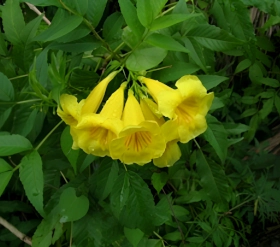
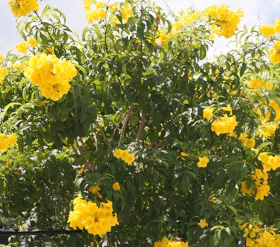
Note on synonyms: Older labels may read Stenolobium stans or Bignonia stans — both are synonyms of the accepted name.
How to Identify
- Habit: An evergreen to semi-deciduous shrub or small tree, usually 2–5 m tall in Thailand, with an upright trunk and a rounded to egg-shaped, rather open crown. It often produces root suckers, so mature plants form clusters of stems around the main crown.
- Bark: Pale to light brown, thin and fairly smooth on young stems, becoming shallowly fissured and corky-grey with age. Twigs are slender, greenish when young, with conspicuous raised lenticels.
- Leaves — the key character: Opposite (in pairs, decussate), and odd-pinnately compound — a feature that immediately separates it from most yellow-flowered shrubs in Thai gardens. Thai horticultural sources give 2–4 pairs of leaflets on a petiole 3–6 cm long, though vigorous shoots carry more; leaflets are oblong to lance-shaped, 2.5–15 cm long, with clearly toothed (serrate) margins, a tapering pointed tip, thin texture, and bright green upper surface.
Common error: some Thai garden references describe the leaf as "ใบประกอบแบบขนนกสองชั้น" (bipinnate). Botanically it is once-pinnate (imparipinnate) — a single row of leaflets plus one terminal leaflet.
- Flowers: Bright golden-yellow, held in terminal racemes or panicles 5–12 cm long at the branch tips. The green calyx is a small five-lobed cup 5–8 mm long; the corolla is fused into a funnel-shaped trumpet or bell that widens toward five spreading, slightly frilled lobes, often with faint orange-brown nectar guides in the throat. Individual flowers are 4–5 cm long.
- Fruit: A distinctive slender, flattened, bean-like capsule 10–20 cm long and less than 1 cm wide, green ripening to pale brown, hanging in dangling clusters. It splits along two seams to release many flat, papery seeds with a translucent wing on each side.
- Field summary: Opposite pinnate leaves with toothed leaflets + yellow trumpet flowers + long thin bean-like pods = Tecoma stans.
Ecological Importance
A genuinely valuable pollinator plant. The shrub is an excellent source of pollen and nectar, attracting diverse insect pollinators and several bird species. A detailed Brazilian study found T. stans served as an important food resource for 48 bee species; the most abundant effective pollinators were Centris tarsata and Exomalopsis fulvofasciata, while the stingless bee Scaptotrigona depilis was the commonest nectar robber, and 87.5% of visitors took nectar only. In Thailand the flowers are worked heavily by carpenter bees (Xylocopa), honeybees, stingless bees, and sunbirds — the deep tube suits long-tongued and hovering visitors.
Year-round forage. Because it flowers almost continuously in warm climates, it provides nectar in the gaps between the main flowering seasons of native trees — ecologically useful in a manicured campus landscape with few nectar sources.
Hardiness and land rehabilitation. Its drought tolerance and wide soil adaptability give it real potential for re-greening waste and degraded land outside its invasive range. It is also planted in wide belts as a screening and noise-buffering shrub along roads.
The invasive caution — important for a campus sign. Tecoma stans is anemochorous (wind-dispersed), and its ability to flower and fruit year-round produces copious wind-borne seed — a major driver of its invasiveness. It also spreads vegetatively by root suckers, flowers from its second year, tolerates drought and many soils, and resists most pests and diseases. It is recognised as an invasive species in Argentina, Australia, South Africa, the Pacific Islands, and tropical Asia, and is classified as a Category 1 invasive alien species in South Africa.
Good practice on campus: remove the pods before they split. Deadheading spent flower clusters both prolongs blooming and prevents escape into surrounding scrub.
Uses and Importance
Food
Tecoma stans is not a human food plant — no part is a vegetable, fruit, or culinary herb, and the leaves and roots should not be eaten casually. Its food-web value is indirect: it is a first-rate honey and bee-forage plant, and hives near stands of yellow bells produce a pale, mild honey. The flowers are also occasionally used ornamentally as a plate garnish. In Mexico the roots are reported in the ethnobotanical literature to have been used in brewing a fermented drink. Compounds from the plant have documented applications as a flavouring and perfumery ingredient and as a lubricant and cosmetic component.
Medicinal — by plant part
These are documented traditional uses plus laboratory and animal findings. The plant is one of the most-studied "antidiabetic herbs" in Latin America, but the evidence is genuinely mixed (see the honesty note below). Do not self-medicate, and never substitute it for prescribed diabetes medication.
Overall traditional profile. In traditional medicine the plant is used for diabetes, skin problems, wound healing, inflammation, snakebite, respiratory complaints, cough, cold, fever, and intestinal worms. In Mexico and Central America, where it is called tronadora, it is used specifically for control of diabetes and urinary disorders. Across the ethnobotanical record, the parts most used therapeutically are the leaves, followed by the fruits, aerial parts, root, flowers, seeds, and whole plant, and the commonest preparation is an infusion (a hot-water tea).
Leaves — by far the most used and most studied
- Antidiabetic (the classic use): The leaves contain the monoterpene alkaloids tecomine and tecostanine (tecostatine), described as potent hypoglycaemic agents when given intravenously. Tecomine and chlorogenic acid from the leaves have demonstrated glucose-lowering ability. Tecomine stimulates glucose uptake by adipocytes isolated from normoglycaemic rats.
- Mechanism: A key study concluded that the main antidiabetic effect of the aqueous extract is inhibition of intestinal α-glucosidase, lowering the post-meal glucose peak; sub-chronic administration also reduced triglycerides. Another study showed the aqueous extract modulates intestinal glucose absorption in rats.
- Anti-obesity: The flavones chrysoeriol and apigenin isolated from the leaves have been investigated as pancreatic lipase inhibitors.
- Antifungal: A trypsin inhibitor (TesTI) purified from the leaves inhibits growth of Candida albicans and C. krusei by promoting ATP depletion and lipid peroxidation, without cytotoxicity to human blood mononuclear cells. Separately, an ethanolic leaf extract was inhibitory and fungicidal against C. tropicalis and C. albicans.
- Neuroprotective: Leaf extract has been evaluated against streptozotocin-induced diabetic neuropathy, an effect attributed to the tecostanine/tecomine alkaloids together with saponins and flavonoids.
- Green nanotechnology: Leaf and flower extracts are used to synthesise silver nanoparticles for biomedicine, food packaging, and wound healing.
Flowers
- Antibacterial: Flower extracts have been tested against the Gram-positive Staphylococcus aureus and Enterococcus faecalis and the Gram-negative Pseudomonas aeruginosa, producing measurable zones of inhibition.
- Nephroprotective: A floral extract was reported as a potent inhibitor of gentamicin-induced kidney damage in vivo.
Roots and root bark
- The root is among the parts used therapeutically. Traditional Latin American use of the root is chiefly as a diuretic and tonic and, historically, in remedies for urinary complaints — consistent with the documented use of the plant for urinary disorder control across Mexico and Central America.
Fruits, seeds, and aerial parts
- Fruits rank second only to leaves in frequency of therapeutic use, with the aerial parts, seeds, and whole plant also recorded — usually in the same infusion form.
Documented pharmacological activities (whole plant): antidiabetic, anti-inflammatory, anticancer, antimicrobial, antioxidant, hepatoprotective, cardioprotective, and nephroprotective, from over a hundred isolated compounds whose main classes are flavonoids, alkaloids, phenolic acids, and fatty acids. The species contains more than 120 chemical compounds.
Honest scientific caveat — worth teaching. The famous antidiabetic reputation is not settled science. The effect was originally attributed to tecomine and tecostatine, but Costantino and colleagues failed to observe any hypoglycaemic effect from four purified alkaloids, including tecomine and tecostanine, in db/db mice, and the rational use of the traditional infusion has been called controversial. A 1985 paper in the Journal of Ethnopharmacology asked the question directly in its title: "Is the Tecoma stans infusion an antidiabetic remedy?" Reviewers also note a shortage of in vivo studies, especially adequate dosage and toxicity studies. This is an excellent example for students of the gap between a strong traditional reputation and confirmed clinical evidence.
Economic
Grown worldwide as a landscape and hedge shrub and cultivated commercially as a potted flowering plant; it is one of the most widely planted ornamentals across the plains of the Indian subcontinent and throughout Thai roadside and institutional landscaping, valued for fast growth, year-round colour, and minimal irrigation. Secondary value comes from honey production, from its potential in rehabilitating degraded and waste land, from roadside noise and dust screening, and from its use as a feedstock in nanoparticle research.
Cultural
- Thailand: ทองอุไร contains ทอง ("gold"), so it is planted as a มงคล (auspicious) plant, traditionally believed to bring wealth and prosperity to the household. It is a standard planting at temples, schools, government offices, and highway medians. The name ดอกละคร ("theatre flower") refers to the flower's resemblance to the golden ornaments of classical Thai dance costume.
- The Americas: T. stans is the official flower of the United States Virgin Islands and the floral emblem of the Bahamas. In Mexico the name tronadora — "the thunderer" — comes from the popping sound of the ripe pods splitting open.
- Conservation status: Least Concern (IUCN).
Distribution & Habitat
Native range: The Americas — southern USA, Mexico, the Caribbean, Peru, and Ecuador.
Introduced range: Now pantropical. It is naturalised in Australia, south and southeast Asia, South Africa, eastern Africa, and warm oceanic islands, and it is a widely distributed ornamental across the Indian subcontinent.
Habitat preferences: Full sun is essential — plants growing in shade, or competing with other vegetation, produce sparse inflorescences or buds that fail to open fully. It accepts a wide range of soils provided drainage is good, is strongly drought-tolerant once established, and is notably resistant to pests and diseases. It does not tolerate waterlogging or hard frost.
In Thailand: Introduced from the American tropics and the West Indies and now planted nationwide as a fast-growing, easy, year-flowering ornamental. In Saraburi's climate it thrives on well-drained ground with full afternoon sun and needs almost no supplementary watering after its first year.
Flowering & Fruiting
Flowering season: Effectively year-round in Thailand — a large part of its horticultural appeal — with the heaviest flush in the cool-dry season, roughly November to February, and repeat flushes after rain in the wet season. Its capacity to bear flowers and fruit round the year across varied agro-climates is precisely what makes it so prolific.
First flowering: Plants begin flowering in their second year from establishment.
Practical care point: Flowers form on new growth, so cutting back hard after each flush triggers the next. Severe drought causes abscission of flower buds and failure of buds to open, so a deep watering during extended dry spells preserves the display.
Fruiting: Best fruit set was recorded in the winter/cool season, likely because of clear, sunny weather, though pods also form in the hot and rainy seasons at varying intensity. Seed set depends on air temperature, humidity, wind speed, and pollinator availability.
Seed dispersal: The ripened pods continue releasing wind-borne seeds over an extended period until fully weathered. The seeds are orthodox — they can be stored for long periods under good conditions without much loss of germination. The plant also perpetuates itself vegetatively through root suckers arising in clusters around the crown.
Did You Know?
- Its Mexican name means "the thunderer." Tronadora refers to the sound the dry pods make as they crack open and fling out their winged seeds — the same explosive dispersal mechanism that makes the plant a Category 1 invasive alien in South Africa. A single shrub can broadcast seed across an entire hillside on a windy afternoon.
- It feeds an entire bee community, not just a few visitors. One study of urban T. stans recorded 48 species of bees using the flowers as a food resource — but also found that a stingless bee, Scaptotrigona depilis, was the most frequent nectar robber, biting through the base of the corolla to steal nectar without ever touching the anthers. On any campus shrub you can watch honest pollinators and thieves working the same flower cluster.
- It is one of the world's most-cited "diabetes herbs" — and one of the best cautionary tales in pharmacognosy. Mexican traditional medicine has used the leaf infusion for centuries, and the alkaloid tecomine really does drive glucose into fat cells in the lab, yet purified tecomine and tecostanine failed to lower blood sugar in diabetic mice. The most convincing modern explanation isn't the famous alkaloids at all, but a much humbler mechanism — the whole extract slowing sugar absorption in the gut by blocking α-glucosidase.
References
- Singh, S., Miller, C.T., Singh, P., Sharma, R., Rana, N., Dhakad, A.K. & Dubey, R.K. (2024). A comprehensive review on ecology, life cycle and use of Tecoma stans (Bignoniaceae). Botanical Studies, 65: 6. doi:10.1186/s40529-024-00412-4 (PMC10861415)
- Al-Snafi, A. et al. (2021). A review on phytochemistry and pharmacological uses of Tecoma stans (L.) Juss. ex Kunth. Journal of Ethnopharmacology, 274: 114078.
- Alonso-Castro, A.J. et al. (2010). The antidiabetic plants Tecoma stans and Teucrium cubense induce the incorporation of glucose in insulin-sensitive and insulin-resistant adipocytes. Journal of Ethnopharmacology, 127(1): 1–6.
- Aguilar-Santamaría, L. et al. (2009). Antidiabetic activities of Tecoma stans (L.) Juss. ex Kunth. Journal of Ethnopharmacology, 124(2): 284–288. PMID: 19397980
- Costantino, L. et al. (2003). Isolation and pharmacological activities of Tecoma stans alkaloids (tecomine, 5β-hydroxyskitanthine, boschniakine).
- Lozoya-Meckes, M. & Mellado-Campos, V. (1985). Is the Tecoma stans infusion an antidiabetic remedy? Journal of Ethnopharmacology, 14(1): 1–9.
- Hammouda, Y. & Khalafallah, N. (1971); Hammouda, Y. et al. (1964). Studies on the alkaloids tecomine and tecostanine of Tecoma stans.
- Ramirez, G. et al. (2012). Pancreatic lipase inhibition by chrysoeriol and apigenin from Tecoma stans.
- Freire, J.E.C. et al. (2016). A trypsin inhibitor from Tecoma stans leaves inhibits growth and promotes ATP depletion and lipid peroxidation in Candida albicans and C. krusei. Frontiers in Microbiology. (PMC4847156)
- Raju, S., Kavimani, S., Uma Maheshwara Rao, V., Sreeramulu Reddy, K. & Vasanth Kumar, G. (2011). Floral extract of Tecoma stans: a potent inhibitor of gentamicin-induced nephrotoxicity in vivo. Asian Pacific Journal of Tropical Medicine, 4(9): 680–685.
- Anjos, M.C. et al. (2007). Bee diversity in Tecoma stans (L.) Kunth (Bignoniaceae): importance for pollination and fruit production. Neotropical Entomology. PMID: 17710317
- CABI Compendium (2019). Tecoma stans (yellow bells) datasheet. doi:10.1079/cabicompendium.52951
- Lucid / EAfrinet Weeds Key — Factsheet: Tecoma stans (Yellow Bells).
- Pelton, J. (1964). A survey of the ecology of Tecoma stans. Butler University Botanical Studies, 14(2): 53–88.
- Thailand Biodiversity Information Facility (THBIF), ONEP — ทองอุไร Tecoma stans. https://thbif.onep.go.th/taxons/detail/39831
- Bangkok City Library / Zoological Park Organization of Thailand — ทองอุไร plant records.
- Baan Lae Suan (บ้านและสวน) — ต้นทองอุไร: ลักษณะและการปลูก.