
AIU Campus Plant Profile
Teak
Tectona grandis L.f.
A name worth knowing. สักทอง (Sak Thong, "golden teak") is not a separate species — it is simply the trade name for high-quality teak timber, and it is this wood that built Vimanmek Mansion and northern Thai temple architecture. Figured heartwood with dark streaks carries its own name again: สักทองลายดำ, prized by carvers and collectors.
How to Identify
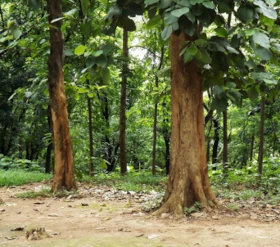
- Habit: A large deciduous tree, 25–40 m tall, with a straight cylindrical bole and a base that is often slightly buttressed or fluted. Stands leafless through the hot dry season.
- Bark: Pale grey to greyish-brown, fibrous, shallowly fissured, peeling off in long thin strips.
- Twigs: Stout and distinctly four-angled (square in cross-section), with a large soft pith and a dense covering of star-shaped (stellate) hairs.
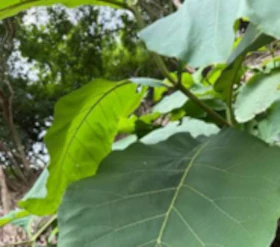
- Leaves: Opposite, in pairs set at right angles, and enormous — usually 30–60 cm long, but up to 90 cm on saplings and coppice shoots. Elliptic to obovate, margin entire, base tapering. The upper surface is rough like sandpaper; the underside is greyish and velvety-mealy with dense stellate hairs.
- The field test: Crush a young leaf between your palms — it releases a blood-red sap that stains the skin. Almost nothing else on campus does this, and it is the quickest way to confirm teak anywhere in its range.
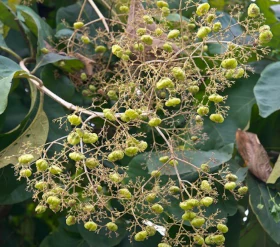
- Flowers: Small (6–8 mm), white to cream, fragrant, borne in very large branched terminal panicles up to 45 cm or more across, held above the foliage.
- Fruit: A hard rounded drupe about 1.2–1.8 cm, completely enclosed in an inflated, papery, bladder-like calyx — it looks like a small brown paper lantern and rattles when shaken.
Ecological Importance
- Keystone canopy tree of the mixed deciduous forest (ป่าเบญจพรรณ) of northern Thailand, structuring the forest type that bears its name.
- Fire-adapted: thick fibrous bark and a deep root system allow mature trees to survive the seasonal ground fires typical of deciduous forest.
- Pollinator resource: the large panicles open at the start of the rainy season and are heavily worked by bees, wasps, flies and beetles — a significant nectar and pollen source.
- Seed dispersal: the inflated calyx acts as both a wind-catcher and a float, so fruits travel on seasonal streams and are also moved by rodents.
- Wildlife habitat: old hollow teak trees are important nest sites for hornbills, owls and parakeets, and roosting sites for bats.
- Insect host plant: teak is the host of the teak defoliator moth (Hyblaea puera) and the teak skeletonizer (Eutectona machaeralis), which can strip entire stands; these outbreaks in turn feed birds, bats and parasitoid wasps.
- Carbon and soil: long-lived and dense-wooded, teak is a substantial long-term carbon store.
Campus note: in pure plantations the very large leaves concentrate rainfall into heavy drips, and where the understory is cleared or burned this causes measurable splash erosion — teak monoculture is not ecologically equivalent to natural teak forest, so keeping ground cover under campus specimens matters.
Uses and Importance
Food
- Not a food crop, but the leaves are widely used in cooking.
- Leaf wrappers — young leaves are used to wrap rice cakes, fermented foods and, in Java, tempeh and nasi jamblang.
- Natural colouring — the red pigment in the leaves gives a reddish-brown colour to rice cakes and to Javanese gudeg.
- Seed oil is edible in small quantities but is used mainly for lamps and hair oil rather than for cooking.
Medicinal — By Part and Ailment
Traditional and folk uses recorded in Thai, Indian and Indonesian medicine. These are ethnobotanical records, not clinically established treatments — do not self-medicate.
| Part | Traditionally Used For / Documented Activity |
|---|---|
| Leaf | Poultice on wounds, burns and boils; decoction for skin complaints, scabies and ringworm; used as a hemostatic to stop bleeding; leaf extract taken in folk practice for diabetes and as an anti-inflammatory |
| Bark | Astringent; decoction for diarrhea and dysentery, bronchitis, and to reduce fever |
| Heartwood / sawdust | Paste applied to the forehead for headache; used for "burning sensation" and biliousness; applied to skin conditions such as scurf and ringworm |
| Root | Decoction for urinary retention and urinary tract complaints; also applied to swellings |
| Flower | Used for bronchitis, biliousness and urinary discharges |
| Fruit | Regarded as diuretic; used in urinary complaints and as a hair tonic |
| Seed / seed oil | Rubbed into the scalp to promote hair growth; applied for itch and scabies |
Occupational caution: teak sawdust and shavings contain quinones (tectoquinone, lapachol, deoxylapachol) that cause contact dermatitis and eye and respiratory irritation in carpenters. Sanding teak without a mask is a genuine occupational hazard.
Economic
- One of the world's premium hardwoods. Its durability comes from tectoquinone (2-methylanthraquinone) and natural oils in the heartwood, which repel termites and fungi without any treatment. The wood is also unusually dimensionally stable, barely shrinking or warping.
- Uses: ship decking and marine joinery, high-end furniture, doors and window frames, carving, temple and palace architecture, railway carriages and garden furniture.
- In Thailand, teak was the backbone of the northern economy from the 1880s to the 1950s, worked by European concession companies using elephants, with logs floated down the Ping, Wang, Yom and Nan rivers to Bangkok.
- Commercial logging in Thailand's natural forests was banned in 1989. Teak now comes from plantations, largely those of the Forest Industry Organization (FIO), and its cutting and transport remain legally regulated.
- Grown as a plantation crop across the tropics — India, Myanmar, Indonesia and Laos, and widely in West Africa and Latin America.
- Minor products: leaves yield a yellow-brown to red dye for cloth, bark yields tannin, and seeds yield oil.
Cultural
- สักทอง (golden teak) is the most prestigious building timber in Thai tradition, reserved for temples, palaces and the great Lanna houses. Vimanmek Mansion in Bangkok, built in 1900, is described as the largest golden-teak building in the world.
- Teak pillars and carved gables define northern Thai temple and vernacular architecture, and figured สักทองลายดำ is prized by carvers and collectors.
- Teak is the provincial tree of Uttaradit Province, where the country's most famous ancient teak trees stand.
- The teak trade created the culture of the northern logging elephant and its mahouts — a tradition that ended with the 1989 ban and now survives in the conservation centres around Lampang.
- In India, teak is the traditional wood for temple doors and processional chariots.
Distribution & Habitat
- Native range: India, Myanmar, Thailand and Laos, with long-established populations in Java and nearby Indonesian islands (whether these are native or very ancient introductions is still debated).
- Introduced and naturalised across the tropics: Sri Lanka, Bangladesh, Vietnam, the Philippines, Papua New Guinea, West and East Africa (Nigeria, Côte d'Ivoire, Ghana, Tanzania) and tropical America (Costa Rica, Panama, Brazil, Ecuador, Trinidad).
- Climate: monsoon tropics with a pronounced dry season of 3–5 months; annual rainfall 800–2,500 mm; from sea level to about 1,000–1,200 m altitude.
- Soil: demands deep, well-drained, base-rich alluvial or limestone-derived soils at near-neutral pH (about 6.5–7.5). It performs badly on waterlogged ground and on acidic lateritic soils.
- Light: strongly light-demanding — teak seedlings will not establish in shade, which is why it regenerates after fire, flood or clearing rather than under a closed canopy.
- In Thailand: natural teak forest is confined to the north and upper west — Chiang Mai, Chiang Rai, Lampang, Lamphun, Phrae, Nan, Tak and Uttaradit — reaching its natural southern limit around Kanchanaburi and Uthai Thani. Trees in Saraburi, including those on the AIU campus, are planted, well south of the natural range.
Flowering & Fruiting
New leaf flush: April–May, with the first pre-monsoon rains.
Flowering: June–September in Thailand, peaking shortly after the monsoon breaks. Individual flowers are bisexual and open for a single day.
Fruiting: fruits develop from August onward and mature November–January, then drop from December through February, often persisting on the ground in their papery calyx for months.
Leaf fall: January–March; the trees stand bare through the hottest part of the year.
Fruit set is famously poor — typically only 1–3% of flowers form fruit — and the seeds have a hard shell that must be alternately soaked and dried before it will germinate.
Did You Know?
- Green teak logs sink. Freshly cut teak is too dense to float, so traditional loggers girdled standing trees and left them to die and dry for two to three years before felling, purely so that the logs could be floated downriver.
- Teak built navies. Its termite and rot resistance made it the preferred deck and hull timber of the British and Indian navies, and it remains the standard for luxury yacht decking today.
- Teak blunts saws. The wood contains silica, which dulls blades so quickly that mills schedule sharpening around it.
- The red-hand test. The crimson stain from crushed young leaves is used both as a dye and as the quickest field identification for teak anywhere in its range.
- Ton Sak Yai (ต้นสักใหญ่) in Nam Pat District, Uttaradit, is Thailand's most famous teak tree — roughly 10 m in girth and around 37 m tall, with an estimated age of some 1,500 years.
- Teak is a mint relative. Its move from Verbenaceae to Lamiaceae came from DNA evidence in the early 2000s — meaning teak is a close relative of basil, mint and Thai holy basil (กะเพรา).
References
- POWO (2024). Plants of the World Online — Tectona grandis L.f. Royal Botanic Gardens, Kew.
- Smitinand, T. (2014). Thai Plant Names, revised edition. Forest Herbarium, Department of National Parks, Wildlife and Plant Conservation, Bangkok.
- Flora of Thailand — Lamiaceae (Verbenaceae s.l.) account.
- Tewari, D. N. (1992). A Monograph on Teak (Tectona grandis Linn. f.). International Book Distributors, Dehradun.
- Kaosa-ard, A. (1981). Teak: Its Natural Distribution and Related Factors. Natural History Bulletin of the Siam Society.
- Orwa, C. et al. (2009). Agroforestree Database: Tectona grandis. World Agroforestry Centre (ICRAF).
- PROSEA (1993). Plant Resources of South-East Asia 5(1): Timber Trees — Major Commercial Timbers.
- Kollert, W. & Cherubini, L. (2012). Teak Resources and Market Assessment. FAO Planted Forests and Trees Working Paper FP/47/E.
- Warrier, P. K. et al. (1996). Indian Medicinal Plants: A Compendium of 500 Species. Orient Longman.