
AIU Campus Plant Profile
Madagascar Almond
Terminalia mantaly H.Perrier
(= Terminalia neotaliala Capuron)
⚠ Two naming problems to settle before you print a sign.
1. The scientific name is contested. Terminalia mantaly H.Perrier (1901) is the name in universal horticultural use, and Kew's IPNI carries it. But GBIF, the Catalogue of Life and the IUCN Red List now treat Terminalia neotaliala Capuron (1951) as the accepted name, with T. mantaly as a synonym. Both names refer to the same Madagascan tree. Write Terminalia mantaly H.Perrier on the sign with the synonym beneath it.
2. หูกระจง is not a one-to-one name. In Thai horticulture the name is applied to more than one Terminalia. Thai botanical databases, including Royal Park Rajapruek, list หูกระจง as Terminalia ivorensis A.Chev. (Black Afara, a West African species), while nurseries sell the Madagascar almond under the same name. Some sellers even list a claimed hybrid. Check your campus tree against the leaf description below before labelling it — the two are easy to tell apart once you know what to look for.
How to Identify
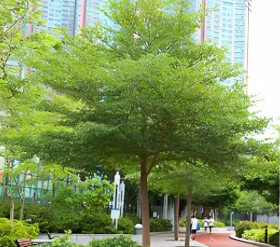
- The silhouette is the identification. Branches emerge in distinct horizontal tiers, each layer separated from the next by roughly half a metre to a metre of bare trunk. The result is a flat-topped, wide-spreading crown that looks like a stack of plates, a pagoda, or a satellite dish — which is where three of its English names come from.
- Habit: Deciduous to semi-evergreen, 10–20 m tall, with a single erect bole. In open-grown specimens the crown is much wider than the tree is tall.
- Bark: Pale grey, smooth and rather mottled, often peeling in thin flakes.
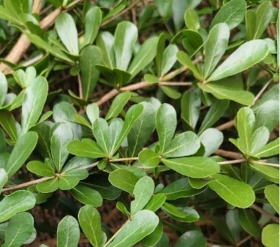
- Leaves — surprisingly small: Obovate, only about 1.5–7 cm long and 1–4 cm wide, glossy bright green, with a broadly rounded or slightly notched apex, a strongly tapered base, and a margin that is often slightly wavy.
- The arrangement is the family signature. Leaves are borne in terminal rosettes of four to nine unequal leaves on short thickened shoots at the very tips of the branchlets. The genus name Terminalia comes from the Latin terminus for exactly this reason — the leaves sit at the ends of the shoots.
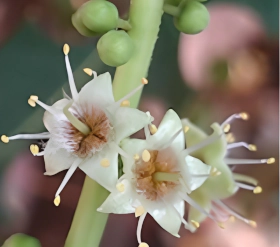
- Flowers: Small and easily missed — 3–5 mm, greenish to creamy-white, in slender erect spikes up to about 5 cm long in the leaf axils.
- Fruit: A small ovoid drupe, 1–2 cm long, green ripening to reddish-brown, containing a single seed with no obvious wings.
- In the dry season the tree drops its leaves and the bare tiered framework becomes even more distinctive — the easiest time of year to identify it from a distance.
- A variegated cultivar, usually sold as 'Tricolor' with cream-margined leaves, is common in the Thai nursery trade.
Telling it apart from its relatives
| Species | Leaves | Fruit | Size & form |
|---|---|---|---|
| หูกระจง — T. mantaly | Tiny, 1.5–7 cm, in rosettes at the shoot tips | Small drupe, 1–2 cm | 10–20 m, strongly tiered |
| หูกวาง — T. catappa | Very large, 15–25 cm, turning red before falling | Large flattened almond-like fruit with an edible kernel | 15–25 m, tiered but coarser |
| T. ivorensis | Noticeably larger than T. mantaly | Small | Much larger tree, to 30 m or more |
Ecological Importance
- In its native Madagascar it grows in dry, humid and subhumid forest from sea level to about 500 m.
- Pollinators: the small spikes are fragrant and worked by bees and other insects, though the flowers are inconspicuous enough that most people never notice them.
- Seed dispersal: the fruits are taken and spread by birds.
- Urban tolerance is its real ecological profile here. It is fast-growing and tolerates poor soils, drought, temporary waterlogging, full sun and urban pollution. The tiered crown delivers a large area of shade from a relatively narrow trunk footprint, which is precisely why it became a standard street and car-park tree across the tropics.
⚠ Two cautions worth stating plainly on a conservation campus.
It is Vulnerable at home and invasive abroad. The IUCN assesses this species as Vulnerable in Madagascar, where its forest habitat is under pressure. On continental Africa, where it has been planted extensively, it is recorded as an invasive species. The same tree, two opposite problems, separated only by where it was put.
It is not a trouble-free street tree. A frequent complaint where it is planted over pavement is vigorous surface rooting that lifts paving and kerbs, and the wide tiered branches need clearance from buildings and power lines. Neither is a reason not to grow it — but both are reasons to think about where.
Uses and Importance
Food
This is not a food plant, despite the name. The "almond" in Madagascar almond refers to the resemblance of the genus to Terminalia catappa, whose kernel genuinely is eaten across Southeast Asia. The seed of T. mantaly is small and is not used as food. If your sign sits near a หูกวาง, this contrast is worth drawing — two trees with almost the same Thai name, one edible and one not.
Medicinal — by Part and Ailment
Traditional uses recorded in Madagascar and East Africa. These are ethnobotanical records, not clinically established treatments.
| Plant Part | Recorded uses |
|---|---|
| Bark | Rich in tannins and used as an astringent; applied in the traditional management of diarrhoea and dysentery. Also harvested as a source of tannins and dyes. |
| Leaves / aerial parts | The plant's folk repertoire includes arterial hypertension, diabetes, colic, intestinal parasitic infections and inflammatory skin conditions. Laboratory work on methanol extracts has found antioxidant activity and inhibition of α-glucosidase and urease. |
| Whole plant / unspecified | Also recorded for oral and digestive candidiasis, other mycotic infections, and postpartum care. |
⚠ This species is much less studied than its famous Indian relatives T. arjuna, T. bellirica and T. chebula (สมอพิเภก and สมอไทย). Do not transfer claims from those species to this one — they are different plants with different chemistry.
Economic
- Ornamental and amenity planting is the dominant use worldwide — street trees, car parks, campuses, resorts and gardens across the tropics.
- Bark yields tannins and dyes, harvested from the wild for local use in Madagascar and Africa.
- Used in reforestation and shade planting, valued for fast growth on degraded sites.
- Timber is a minor product only — the bole is relatively slender and the tree is worth more standing.
- The variegated cultivar commands a premium in the Thai and Southeast Asian nursery trade.
Cultural
- In Thailand this tree has a marketing history worth telling. The ornamental trade renamed it แผ่บารมี — literally "spreading barami", the Buddhist idea of accumulated merit, prestige or protective influence — after the shape of its tiered, outspreading crown. It joins a long Thai tradition of giving plants auspicious names to make them desirable for planting at homes, temples and offices.
- It became one of the defining trees of the Thai landscaping boom of the 2000s and 2010s, planted in enormous numbers along roads and in new developments.
- In Madagascar it is a familiar village and roadside tree rather than a wild-harvested one for most people.
- It has no place in traditional Thai flora or folk belief. Its Thai cultural identity is entirely modern and commercial — which is itself an interesting thing for students to notice.
Distribution & Habitat
- Native range: endemic to Madagascar, in dry, humid and subhumid forest from sea level to about 500 m.
- Introduced widely across the tropics as an ornamental and shade tree — Nigeria, Ghana, Cameroon and elsewhere in Africa; Southeast Asia including Thailand, Malaysia, Indonesia, Singapore and Vietnam; southern China and Taiwan; Australia; and parts of the Americas.
- Soil and site: undemanding. Grows on a wide range of soils including poor and compacted ground, tolerates drought once established and short periods of waterlogging.
- Light: full sun. The tiered branching develops properly only in the open; shaded trees lose the characteristic layered form.
- Climate: lowland tropics. Not frost tolerant.
- In Thailand: planted only, throughout the country. There is no record of naturalised populations, though its invasiveness in Africa means this is worth watching rather than assuming.
Flowering & Fruiting
- Leaf drop: in the Thai dry season, roughly January to March, followed by a rapid flush of new bright green leaves. On wetter sites the tree may hold its leaves and behave as an evergreen.
- Flowering: with or shortly after the new leaf flush, typically in the transition into the rainy season. The spikes are small and greenish and are easy to miss entirely.
- Fruiting: fruits develop through the rainy season and ripen from green to reddish-brown later in the year.
- An honest gap: detailed phenology has not been published for planted trees in Thailand. Your campus specimens are worth recording — flowering date, leaf-fall date, fruit ripening — because this is a tree that thousands of Thai institutions grow and almost nobody documents.
Did You Know?
- The genus name describes the leaves. Terminalia comes from the Latin terminus — "end" or "boundary" — because the leaves of this genus cluster at the very tips of the shoots. Look at any branchlet and you'll see the rosette that earned the name.
- Three English names, all describing the same silhouette. Umbrella Tree, Satellite Tree and Pagoda Tree all refer to the tiered horizontal branching.
- Vulnerable and invasive simultaneously. The IUCN lists it as Vulnerable in Madagascar while it spreads as an invasive on mainland Africa. Where a plant is matters as much as what it is — a useful lesson for a conservation course.
- It has two scientific names in current use, depending on which database you consult. Taxonomy is not always settled, even for a tree planted on half the streets in Bangkok.
- แผ่บารมี is marketing, not tradition. The auspicious-sounding Thai name was coined by the ornamental plant trade to sell the tree, not inherited from Thai folk botany.
- Not the almond you can eat. Its relative หูกวาง (T. catappa) produces a genuinely edible kernel. This one does not.
References
- POWO (2024). Plants of the World Online — Terminalia mantaly H.Perrier. Royal Botanic Gardens, Kew.
- Catalogue of Life / GBIF Backbone Taxonomy — Terminalia neotaliala Capuron (accepted name, with T. mantaly as synonym).
- Rakotoarisoa, S. E. (2019). Terminalia neotaliala. IUCN Red List of Threatened Species 2019: e.T128091759A128098510.
- Capuron, R. & Perrier de la Bâthie, H. Flore de Madagascar et des Comores — Combrétacées, vol. 151 (1954).
- PROTA (Plant Resources of Tropical Africa) — Terminalia mantaly.
- Fern, K. Useful Tropical Plants Database — Terminalia mantaly.
- Burkill, H. M. (1995). The Useful Plants of West Tropical Africa, 2nd ed. Royal Botanic Gardens, Kew.
- Profiling of phytochemicals from aerial parts of Terminalia neotaliala using LC-ESI-MS², with antioxidant and enzyme inhibition assays (2022). PMC8970405.
- Royal Park Rajapruek Plant Database — หูกระจง (Terminalia ivorensis), for the Thai naming comparison.
- Smitinand, T. (2014). Thai Plant Names, revised edition. Forest Herbarium, DNP, Bangkok.
Note for the Sign
Before labelling, confirm which species the campus tree actually is. If the leaves are tiny obovate rosettes at the shoot tips and the crown is sharply tiered, it is the Madagascar almond and this profile applies. If the leaves are noticeably larger and the tree is heading past 25 m, it is more likely Terminalia ivorensis, which shares the Thai name หูกระจง but is a different species from a different continent.
On the sign itself, the most useful thing you can teach a passing student is the contrast with หูกวาง (Terminalia catappa): almost the same Thai name, the same family, the same tiered branching — and leaves ten times the size, with a kernel you can eat.